Story Summary
Discover the legend of Lugh of the Long Arm, the multi-talented hero of the Tuatha Dé Danann who proved that a master of all trades is the greatest king of all.
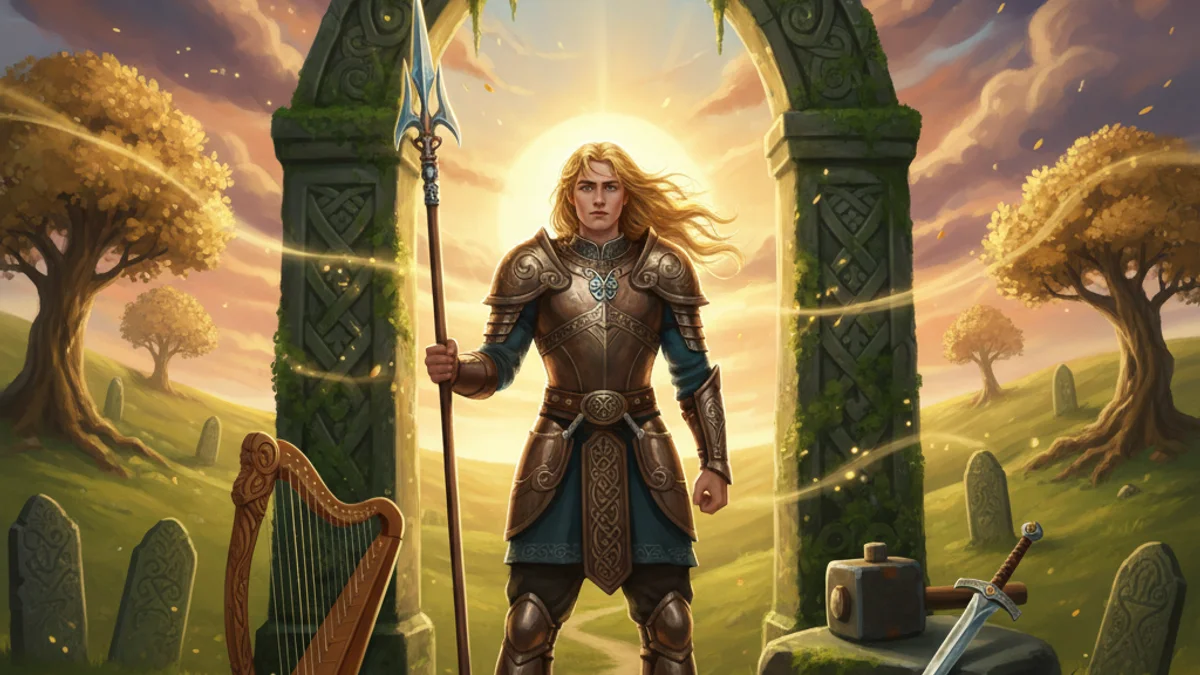
When the Tuatha Dé Danann were oppressed by the monstrous Fomorians, a young stranger approached the gates of Tara. The porter blocked his path, stating that none could enter without a craft not already possessed by those within. Lugh first claimed to be a carpenter, then a smith, a champion, a harper, and a poet. Each time, the porter replied that they already had a master of that trade. Undeterred, Lugh asked, 'Is there any one man among you who is a master of all these arts at once?' The porter had no answer, and Lugh, the Samildánach or 'Master of All Arts,' was granted entry. King Nuada, recognizing Lugh's singular brilliance, yielded his throne to the youth. Leading the gods with his magical spear and unmatched wisdom, Lugh defeated the giant Balor of the Evil Eye at the Battle of Moytura, freeing Ireland from tyranny and ushering in a golden age of light and skill.
The Moral
True greatness is found in versatility and the ability to integrate many talents for a singular, noble purpose.
“Is there any one man among you who is a master of all these arts at once?”
Fun Fact
Lugh is the namesake for the modern Irish month of August, 'Lúnasa,' which originally began as a funeral game festival he held for his foster-mother, Tailtiu.
Frequently Asked Questions
What is the moral of Lugh of the Long Arm?
The story teaches that versatility and a diverse range of skills are more valuable than specializing in just one. It emphasizes that a true leader must understand all aspects of their society to effectively protect and guide it.
Why is Lugh called 'of the Long Arm'?
The epithet 'Lámhfhada' or Long Arm refers to his incredible reach with a spear and his far-reaching influence. It symbolizes his ability to strike from a distance and his command over many different disciplines.
What does the name Samildánach mean?
Samildánach translates to 'skilled in many arts' or 'the polymath.' Lugh earned this title because he was the only member of the Tuatha Dé Danann who mastered every craft, from smithing to poetry.
Who were the Tuatha Dé Danann?
The Tuatha Dé Danann were a race of supernatural beings or gods in Irish mythology. They were said to have ruled Ireland and possessed great magical powers before the arrival of modern humans.
How did Lugh defeat Balor?
Lugh defeated his grandfather Balor by using a sling or spear to strike Balor's 'Evil Eye' just as it opened. The force of the blow drove the eye through the back of Balor's head, turning its destructive gaze onto the Fomorian army.
What is Lugh's legacy in Irish culture?
Lugh remains a central figure in Irish heritage, most notably through the festival of Lughnasadh. Celebrated in August, it is a harvest festival named in his honor that marks the beginning of the ripening season.
Discussion (0)
Share your thoughts on this story
No comments yet. Be the first to share your thoughts!