Story Summary
Discover the Zen story No Water No Moon. A nun's old bucket breaks, leading to a sudden moment of spiritual enlightenment when the reflection disappears.
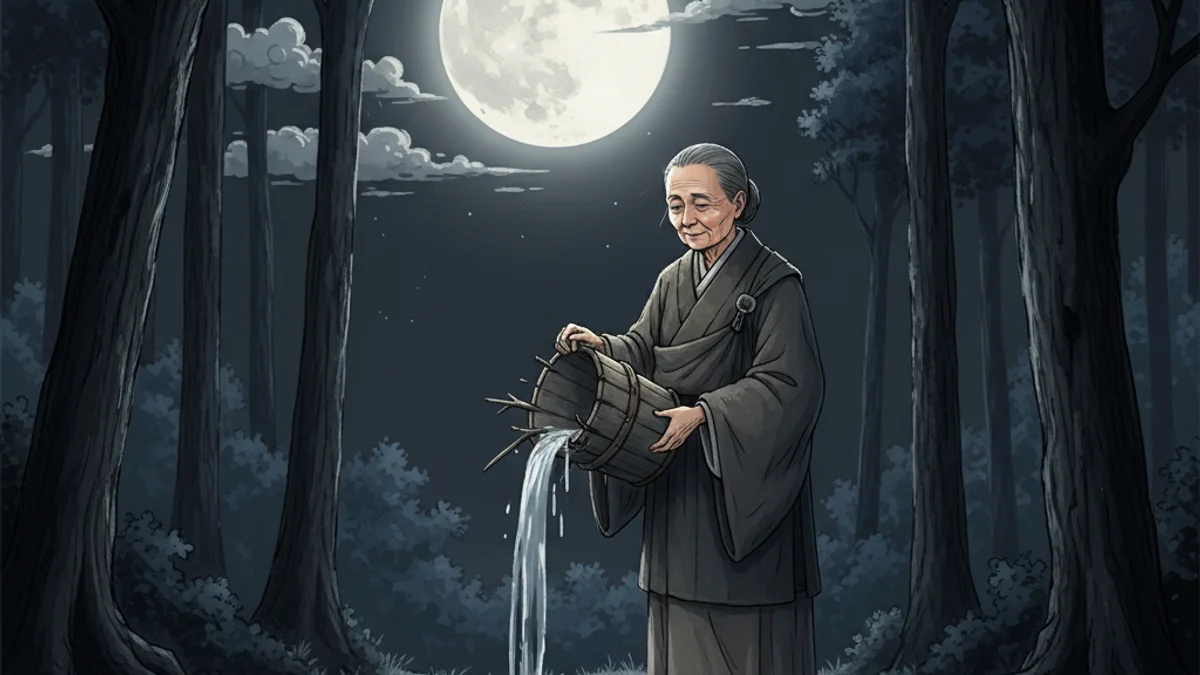
For many years, the nun Chiyono struggled to find enlightenment, studying under various masters to no avail. One evening, as she was carrying an old bamboo bucket filled with water, she walked beneath the glow of the full moon. She watched the moon's pale reflection shimmering on the surface of the water within her bucket. Suddenly, the aging bamboo strips that held the bucket together snapped, and the bottom fell out. The water rushed out into the soil, and the reflection of the moon vanished instantly. In that moment of sudden emptiness, Chiyono’s mind broke free of its attachments. She realized that she had been clinging to a mere reflection of reality. With no water and no moon in the water, she finally attained the clarity she had sought for a lifetime.
The Moral
True enlightenment comes when we let go of our mental attachments and the 'containers' we use to perceive reality, allowing us to see truth directly.
“No more water, no more moon in the water—emptiness in my hand.”
Fun Fact
Chiyono was said to be so beautiful that she had to scar her face to be accepted into a monastery, as the monks found her presence too distracting.
Frequently Asked Questions
What is the moral of No Water No Moon?
The moral is that spiritual truth cannot be found in reflections or intellectual concepts. Enlightenment occurs when we drop our ego-driven attachments and experience reality directly without filters.
Who was the nun in the story No Water No Moon?
The nun is Chiyono, also known as Mugai Nyodai, who was one of the first and most significant female Zen masters in 13th-century Japan.
What does the water bucket represent in Zen?
The bucket represents the human mind and the structures we build to contain our perceptions. When the bucket breaks, it symbolizes the shattering of the ego and the release of limited perspectives.
What does 'No Moon' mean in this context?
It refers to the disappearance of the reflection of the moon. This signifies that the temporary, reflected truth has vanished, leaving only the ultimate, unmediated reality.
How did Chiyono reach enlightenment?
She reached enlightenment through a sudden realization triggered by a physical event. When the bucket broke, her mental 'bottom' also fell out, allowing her to stop chasing reflections and see the void.
Why is this story important in Zen Buddhism?
It is a classic example of 'Satori' or sudden awakening. It emphasizes that years of study can culminate in a single, ordinary moment where everything becomes clear.
Discussion (0)
Share your thoughts on this story
No comments yet. Be the first to share your thoughts!