Story Summary
Explore the epic legend of Odin's Ravens Huginn and Muninn. Learn how Thought and Memory fly across the nine realms to bring news to the All-Father in Asgard.
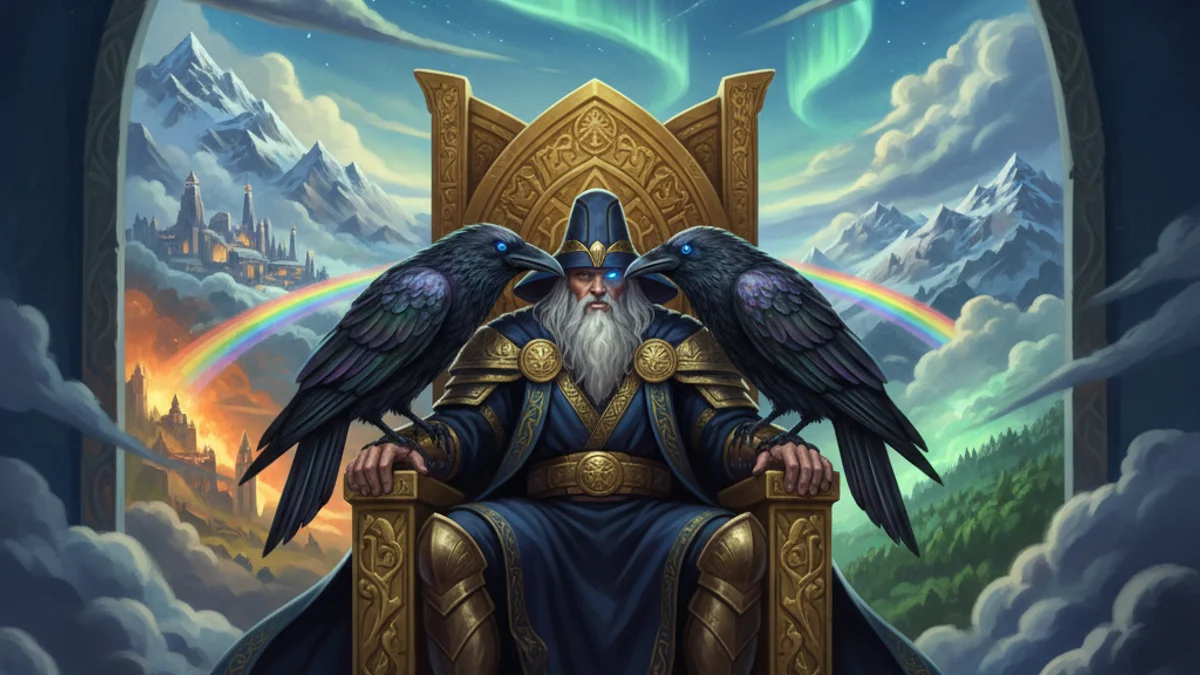
High atop Hlidskjalf, the throne that looks over all the nine realms, sits Odin the All-Father. He is never truly alone, for upon his shoulders perch two jet-black ravens: Huginn and Muninn. Every dawn, Odin sends them forth to fly across the vast expanse of Midgard and beyond. Huginn, whose name means 'Thought,' and Muninn, whose name means 'Memory,' soar over mountains, frozen wastes, and human villages, observing the secret dealings of gods, giants, and men. As evening falls, they return to Asgard, landing back on Odin’s shoulders to whisper everything they have seen and heard into his ears. This constant flow of information grants Odin his renowned omniscience, allowing him to govern with an understanding that spans the globe. Yet, this gift comes with a profound psychological burden. Odin once remarked that while he fears for the return of Thought, he worries even more for the return of Memory, for a ruler who loses his connection to the past is as blind as one who cannot imagine the future.
The Moral
True wisdom requires the constant exercise of both active intellect and the preservation of history.
“Huginn and Muninn fly each day over the wide world; I fear for Huginn that he come not back, yet more I worry for Muninn.”
Fun Fact
In the Poetic Edda, Odin specifically notes that he worries more about losing Muninn (Memory) than Huginn (Thought), suggesting the Norse valued the preservation of the past above all else.
Frequently Asked Questions
What is the moral of Odin's Ravens Huginn and Muninn?
The story emphasizes that wisdom is dependent on the balance of intellect and history. Without active thought and preserved memory, even a god cannot truly understand or lead the world.
What do the names Huginn and Muninn mean?
In Old Norse, Huginn translates to 'Thought' and Muninn translates to 'Memory.' Together, they represent the mental faculties Odin uses to observe and process the state of the universe.
Why did Odin fear his ravens might not return?
Odin's concern reflects the vulnerability of the mind. He feared that 'Thought' might wander too far or that 'Memory' might be lost, signifying the devastating loss of one's identity and wisdom.
Where do Huginn and Muninn go every day?
They fly over all of Midgard (the world of humans) and the other eight realms of Yggdrasil. They act as Odin's eyes and ears, gathering intelligence on every living being.
Are Huginn and Muninn considered good or evil?
They are neither good nor evil; they are extensions of Odin's power. While ravens are often associated with the macabre due to their presence on battlefields, these ravens are revered as symbols of divine wisdom.
How do the ravens communicate with Odin?
The ravens return to Asgard at sunset and perch on Odin's shoulders. They whisper the secrets and events they have witnessed directly into his ears, keeping him all-knowing.
Discussion (0)
Share your thoughts on this story
No comments yet. Be the first to share your thoughts!