Story Summary
Discover the clever tale of Reynard and the Rooster. In this classic trickster fable, Reynard uses flattery to trap his prey, only to be outsmarted in the end.
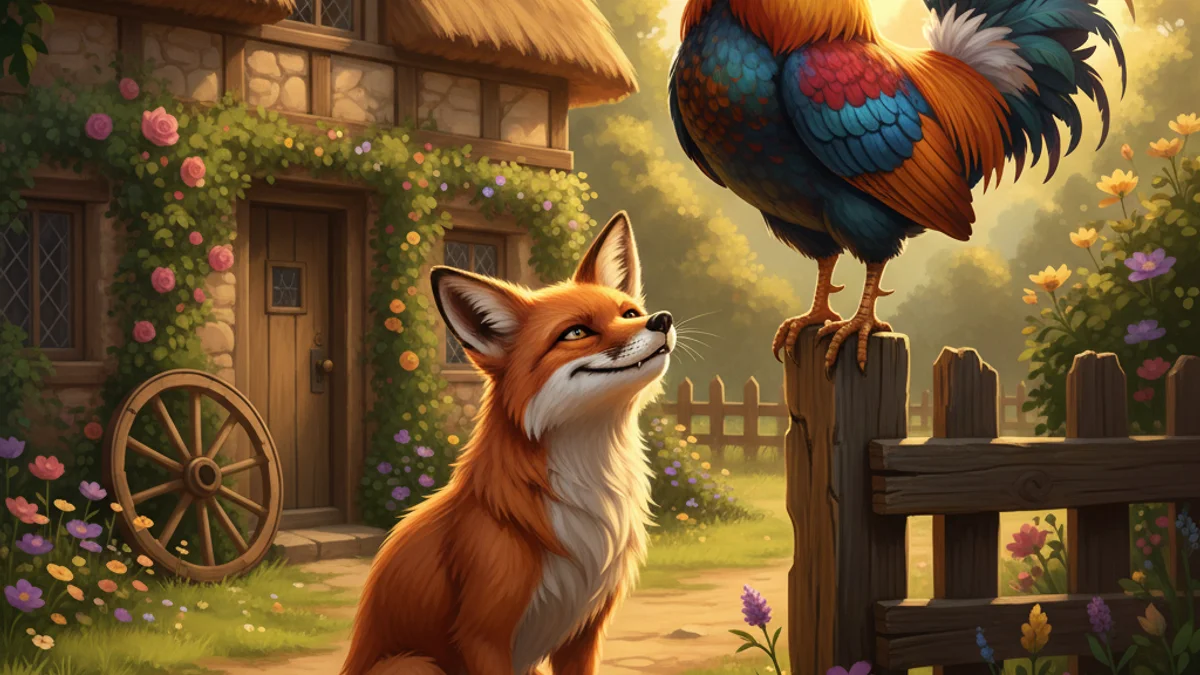
Reynard the Fox, ever hungry and cunning, crept toward the farmstead of Chantecler the Rooster. Finding the proud bird perched upon a fence, Reynard did not strike with claws, but with honeyed words. 'Dear cousin,' Reynard crooned, 'I came only to hear your marvelous voice. Your father was a legend; he could sing so powerfully that he would close both eyes to reach the highest notes.' Vanity swelled within Chantecler. Wanting to prove he was his father's equal, the rooster stretched his neck, shut his eyes tight, and let out a piercing crow. In that moment of darkness, Reynard lunged and seized the rooster by the throat, dashing toward the woods. The farmhands gave chase, shouting in pursuit. Chantecler, though terrified, whispered to the fox, 'Why not taunt them? Tell them I am yours now.' Reynard, unable to resist a final boast, opened his jaws to shout back at the crowd. The instant his grip loosened, Chantecler flew safely into the high branches of a tree. The fox had been out-tricked by his own game.
The Moral
Flattery is a trap for the conceited, and silence is often more powerful than a boastful tongue.
“He who shuts his eyes when he should watch, deserves to lose his sight.”
Fun Fact
Reynard the Fox became so popular in France that the Old French word for fox, 'goupil,' was eventually replaced by 'renard.'
Frequently Asked Questions
What is the moral of Reynard and the Rooster?
The story teaches that flattery is a dangerous tool used by manipulators and that one should never be so proud as to let their guard down. It also emphasizes that there is a time to speak and a time to keep one's mouth shut.
Who is Reynard the Fox in folklore?
Reynard is a classic trickster figure from medieval European folklore, appearing in a collection of anthropomorphic tales known as the Reynard Cycle. He represents the cunning commoner who survives by outsmarting his social superiors and predators.
How does Reynard trick Chantecler?
Reynard uses Chantecler's vanity against him by praising the rooster's singing voice and mentioning his father's talent. He specifically encourages the rooster to close his eyes while crowing, leaving him vulnerable to attack.
How does the rooster escape the fox?
Chantecler uses Reynard's own weapon—trickery—against him. He suggests that the fox should boast of his victory to their pursuers, and when Reynard opens his mouth to speak, the rooster seizes the opportunity to fly away to safety.
Is this story related to Chaucer's Canterbury Tales?
Yes, this fable is the primary source and inspiration for 'The Nun's Priest's Tale' in Geoffrey Chaucer's 'The Canterbury Tales,' where the characters are named Chauntecleer and Daun Russell.
What does the rooster represent in this fable?
Chantecler represents the dangers of vanity and pride. His desire for praise and his need to show off lead him directly into the fox's jaws, though he ultimately redeems himself through quick thinking.
Discussion (0)
Share your thoughts on this story
No comments yet. Be the first to share your thoughts!