Story Summary
Discover the legendary life of The Black Prince, Edward of Woodstock. From the Battle of Crécy to Poitiers, witness the height of medieval English chivalry.
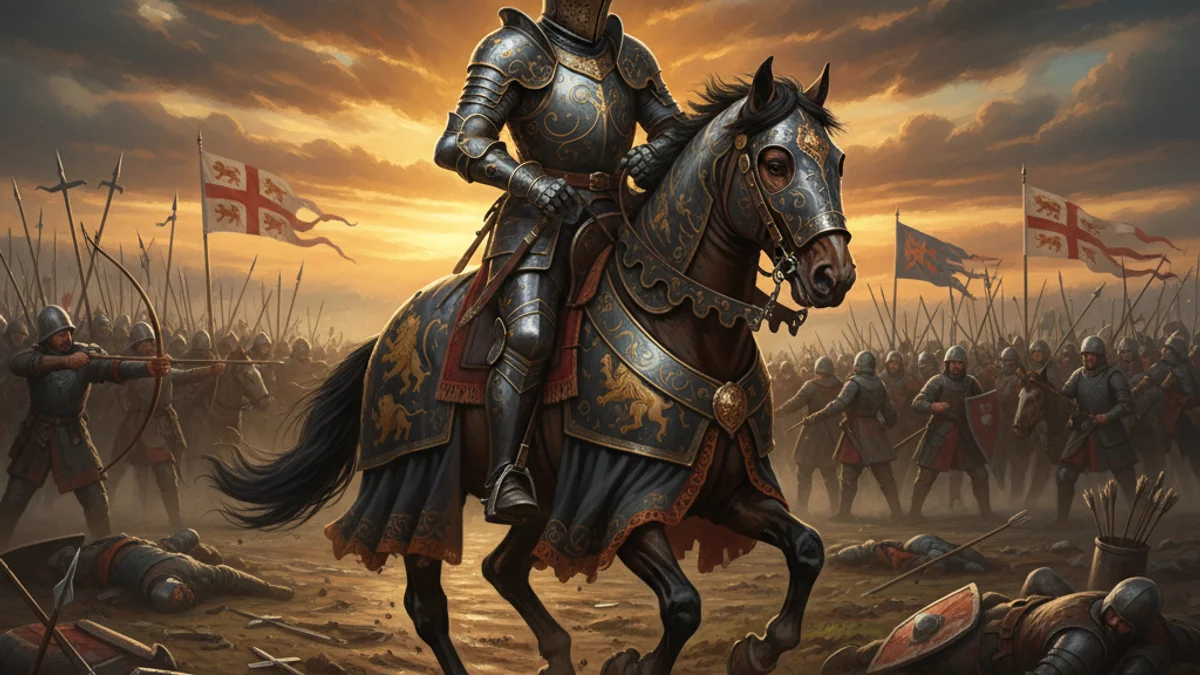
Edward of Woodstock, the eldest son of King Edward III, was the paragon of 14th-century chivalry. At the tender age of sixteen during the Battle of Crécy, he found himself hard-pressed by the French vanguard. When messengers begged the King to send aid, Edward III famously refused, saying, 'Let the boy win his spurs.' The young prince held his ground with grit, emerging victorious and earning his reputation as a formidable commander. Years later at the Battle of Poitiers, he achieved his greatest triumph, capturing King John II of France. In an act of legendary chivalry, the Prince served the captured King at dinner himself, proving that a true knight is as humble in victory as he is fierce in battle. Clad in his iconic dark armor, he became a symbol of English military might across Europe. Though he died before he could claim the throne, his legacy as the greatest warrior of the Middle Ages was forever secured, and his motto 'Ich Dien'—I serve—remains a testament to his dedication to duty.
The Moral
True greatness is defined not just by victory in battle, but by the humility and grace one shows to those who are defeated.
“Let the boy win his spurs, for I wish, if God so order it, that the day may be his.”
Fun Fact
Despite his fame, the name 'The Black Prince' was not used during his lifetime; it first appeared in writing over 150 years after his death.
Frequently Asked Questions
Why was he called the Black Prince?
While popular myth suggests it was due to his black armor, historians believe the name may have come from his brutal reputation in France or was coined long after his death.
Did the Black Prince ever become King of England?
No, he predeceased his father, King Edward III, by one year, meaning the crown passed instead to his young son, Richard II.
What were the Black Prince's most famous battles?
His military career was defined by his decisive victories at the Battle of Crécy in 1346 and the Battle of Poitiers in 1356.
What is the meaning of the Black Prince's motto?
His motto 'Ich Dien' means 'I serve' in German, which he allegedly adopted from the fallen King of Bohemia at the Battle of Crécy.
Where is the Black Prince buried?
He is buried in a magnificent tomb in Canterbury Cathedral, topped with a bronze effigy showing him in full battle armor.
How did the Black Prince die?
He succumbed to a lingering illness, likely dysentery or another chronic condition contracted during his military campaigns in Spain.
Discussion (0)
Share your thoughts on this story
No comments yet. Be the first to share your thoughts!