Story Summary
Discover The Blind Men and the Elephant, a timeless Jain tale teaching that truth is multifaceted and human perspectives are often limited and incomplete.
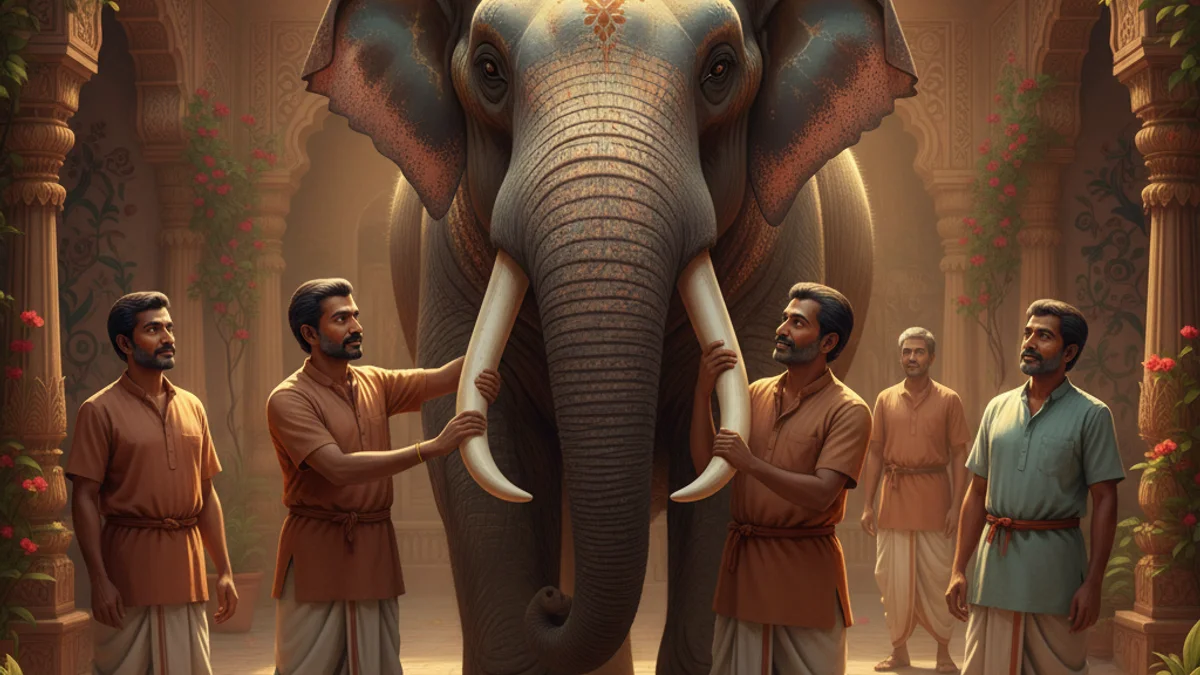
In a peaceful village in ancient India, six blind men lived together, each eager to understand the world through touch. One day, a magnificent elephant was brought to the village. The first man approached and touched the elephant's sturdy side, declaring it was like a wall. The second felt the tusk and argued it was as sharp as a spear. The third, holding the trunk, insisted the creature was like a snake. The fourth grasped the leg and described a thick tree trunk, while the fifth felt the ear and claimed it was a large fan. The sixth, grabbing the tail, was certain it was a rope. Their disagreement grew into a heated argument, as each man was convinced his experience was the absolute truth. A wise man passing by stopped and said, 'You are all right, yet you are all wrong. Each of you has touched only one part. To know the elephant, you must combine all your experiences.' The blind men fell silent, realizing that their individual perspectives were merely fragments of a much larger reality.
The Moral
Truth is multifaceted and complex; our individual perspectives are often limited and should not be mistaken for the absolute whole.
“Each was partly in the right, and all were in the wrong.”
Fun Fact
This story is a primary illustration for the Jain doctrine of Syadvada, which suggests that all judgments are conditional and should be prefaced with 'in some ways'.
Frequently Asked Questions
What is the moral of The Blind Men and the Elephant?
The moral is that reality is complex and multifaceted. It teaches us that our individual experiences are only partial truths and that we must respect other perspectives to understand the whole picture.
Which religion does this story belong to?
While the story appears in Buddhist, Hindu, and Sufi traditions, it is a foundational teaching in Jainism. It illustrates the concept of Anekantavada, or the principle of non-absolutism.
What does the elephant represent in the story?
The elephant represents the ultimate truth, reality, or the divine. Because it is so large and complex, no single person can perceive its entirety through a single point of contact.
How does this story relate to modern communication?
It serves as a reminder to practice empathy and active listening. In modern conflicts, people often argue from their own limited viewpoints without realizing that the other person may also hold a valid piece of the truth.
Who finally resolves the conflict between the men?
A wise man who can see the entire elephant intervenes. He explains that each man is describing a different part of the same animal, reconciling their conflicting reports.
What is the Jain philosophy mentioned in this tale?
The tale illustrates Anekantavada, which suggests that truth and reality are perceived differently from diverse points of view, and no single point of view is the complete truth.
Discussion (0)
Share your thoughts on this story
No comments yet. Be the first to share your thoughts!