Story Summary
Explore The Elephant and the Blind Men, a classic Jataka tale. Learn how different perspectives lead to partial truths in this timeless Buddhist parable.
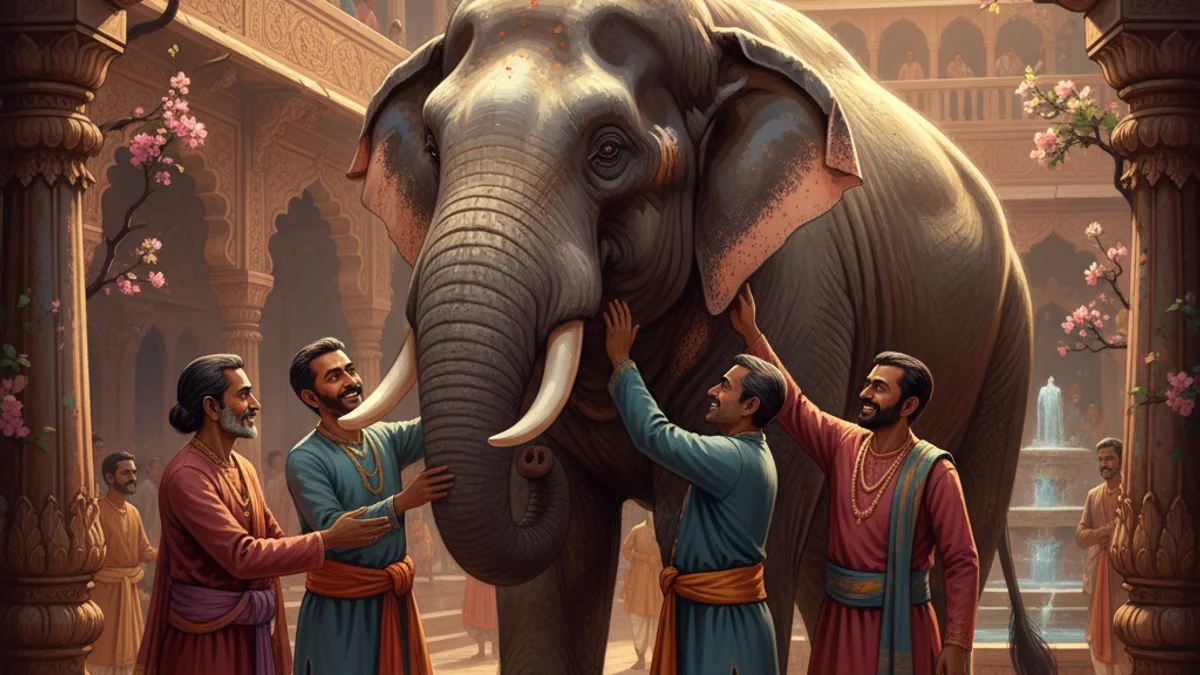
In the city of Savatthi, a king gathered several men who had been blind from birth. He presented an elephant to them and asked each to describe the creature. One man felt the head and said, 'An elephant is like a water jar.' Another touched the ear and declared, 'It is like a winnowing basket.' The one who felt the tusk called it a plowshare, while the man holding the trunk claimed it was a thick snake. The man touching the body called it a wall, and the one holding the tail insisted it was a rope. Soon, the men began to quarrel, each shouting that only his version was correct. The Buddha, observing this, explained that the men were like those who see only part of the Truth. They argue because they are ignorant of the whole, mistaking a single perspective for the complete reality of the world.
The Moral
Truth is multifaceted, and individual perspectives are often limited. We must respect others' views to understand the complete picture of reality.
“They argue and wrangle, for they see only one side of the thing.”
Fun Fact
This parable is found in Buddhist, Hindu, Jain, and Sufi traditions, making it one of the most geographically and religiously widespread stories in human history.
Frequently Asked Questions
What is the moral of The Elephant and the Blind Men?
The story teaches that humans tend to project their partial experiences as the entire truth. It encourages humility and the realization that everyone sees things from a different, limited perspective.
Is The Elephant and the Blind Men a Buddhist story?
Yes, it is a famous parable found in the Udana of the Pali Canon. While also present in Hindu and Jain traditions, the Buddha used it to explain the dangers of religious sectarianism.
What do the different parts of the elephant represent?
Each part represents a partial truth or a subjective experience. For example, the tail as a rope or the ear as a fan shows how one's limited contact can lead to a false conclusion about the whole.
Who wrote The Elephant and the Blind Men?
The story has no single author as it originated in oral traditions across ancient India. It was later recorded in the Buddhist Pali Canon and other religious scriptures over 2,000 years ago.
What is the significance of the elephant in this story?
The elephant represents the absolute truth or reality, which is vast and complex. Its size makes it impossible for any one person to grasp entirely through a single point of contact or perception.
Why did the blind men argue in the story?
They argued because each man was convinced his personal experience was the only reality. Their lack of communication and refusal to consider other viewpoints led to their unnecessary conflict.
Discussion (0)
Share your thoughts on this story
No comments yet. Be the first to share your thoughts!