Story Summary
Discover the Taoist wisdom of The Empty Boat. This classic tale by Chuang Tzu teaches how overcoming the ego leads to peace and freedom from reactive anger.
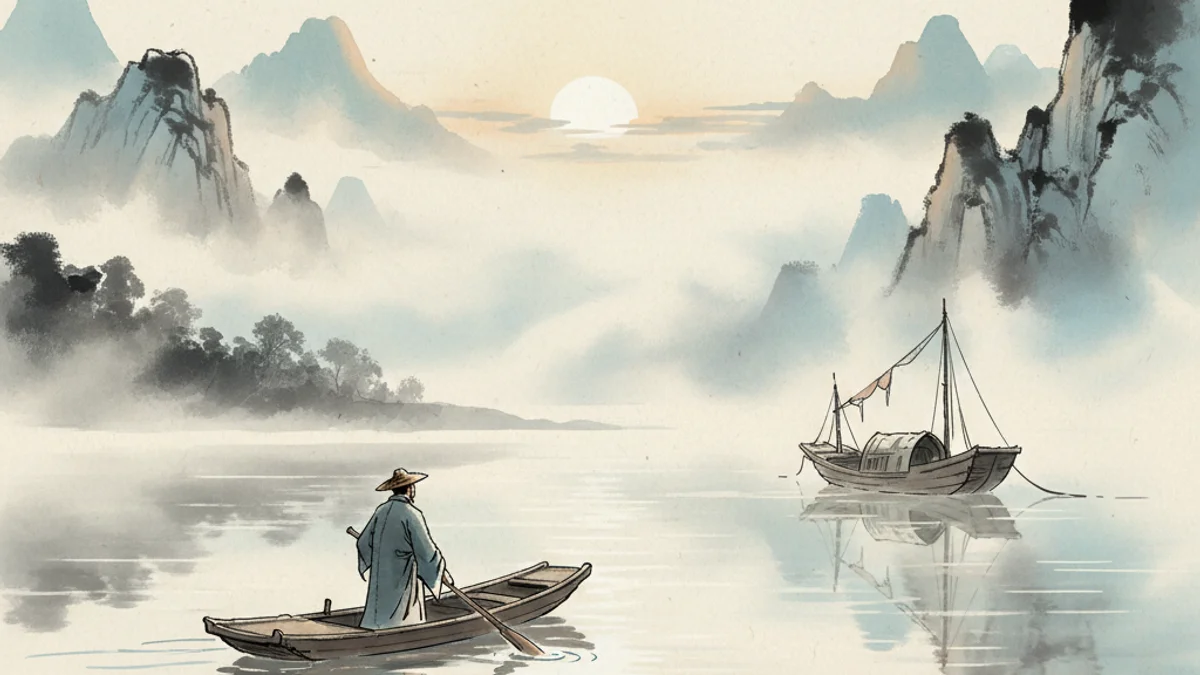
A man was rowing his boat across a wide river when he saw another boat coming downstream toward him. It seemed to be heading straight for his own craft. He shouted, 'Watch out! Veer away!' but the other boat didn't move. He shouted again, louder and more furious, cursing the incompetence of the other rower. Just as he was about to explode with rage, the boats collided with a soft thud. Looking into the other vessel, the man realized it was empty; it had simply broken loose from its moorings and drifted with the current. His anger vanished instantly. He realized that his fury was not caused by the boat, but by his assumption that someone was inside it intentionally causing him trouble. He learned that if a man can empty his own boat of 'self' as he crosses the river of the world, no one will oppose him and no one will seek to harm him.
The Moral
Our anger often stems from our perception of others' intentions; by letting go of our ego, we remain undisturbed by the actions of the world.
“If a man can empty himself and so roam through the world, who can harm him?”
Fun Fact
This story is found in the 'Zhuangzi', one of the two foundational texts of Taoism, which uses humor and parables to explain complex philosophical concepts.
Frequently Asked Questions
What is the moral of The Empty Boat?
The moral is that our anger is usually a reaction to our own ego and the perceived intentions of others. If we view life's obstacles as 'empty boats' rather than personal attacks, we can maintain our inner peace.
Who is the original author of The Empty Boat story?
The story is attributed to Chuang Tzu (Zhuangzi), a foundational Taoist philosopher who lived in China during the 4th century BCE.
What does the empty boat symbolize in Taoism?
The empty boat symbolizes a person who has emptied themselves of ego, pride, and self-importance, allowing them to move through life without creating conflict.
Why does the man's anger disappear when he sees the boat is empty?
His anger disappears because there is no 'other' to blame; he realizes the collision was an accident of nature rather than a personal slight or a sign of disrespect.
How can we apply 'The Empty Boat' to modern life?
We can apply it by not taking things personally. For example, if someone cuts you off in traffic, treat it like an empty boat rather than a personal insult to avoid unnecessary stress.
What is the meaning of 'emptying the self' in this context?
Emptiness refers to letting go of the rigid self-identity that demands respect or special treatment, allowing one to flow with the natural rhythm of the universe (the Tao).
Discussion (0)
Share your thoughts on this story
No comments yet. Be the first to share your thoughts!