Story Summary
Explore the cosmic cycle of The Four Yugas in Hindu Puranas, tracing the decline of Dharma from the golden Satya Yuga to the spiritual darkness of the Kali Yuga.
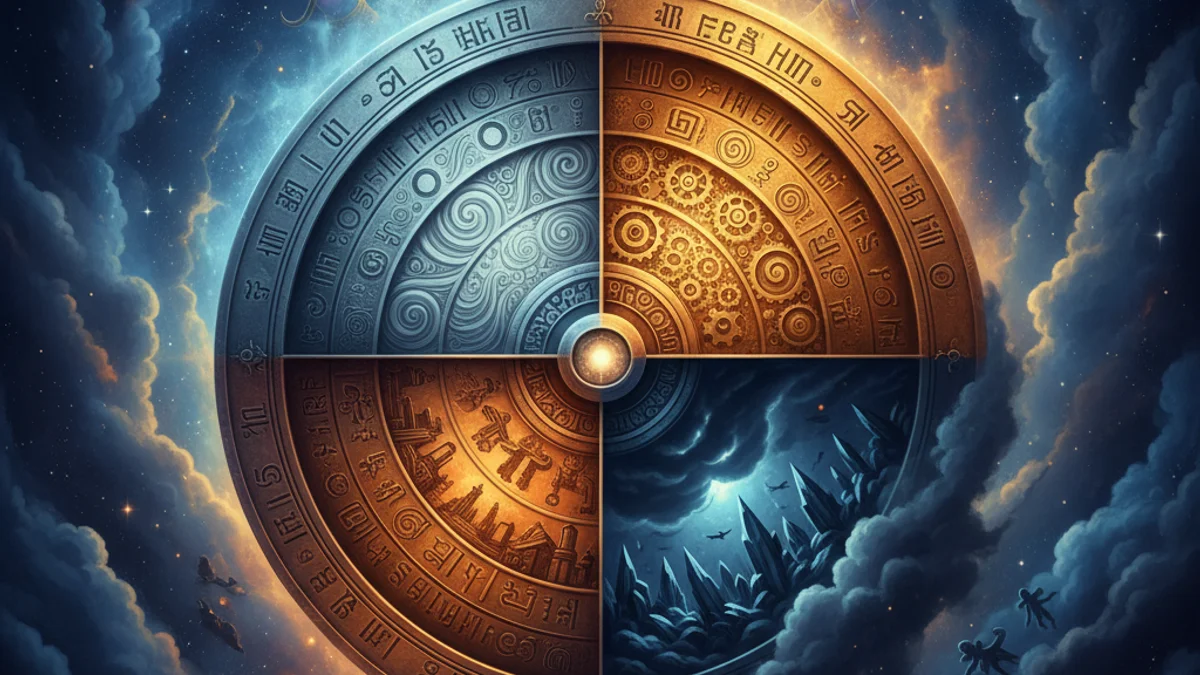
In Hindu cosmology, time is viewed as a vast, cyclical journey known as the Maha Yuga, divided into four distinct ages. The cycle begins with the Satya Yuga, the Golden Age of truth and perfection, where Dharma stands tall on four legs. In this era, humanity lives in harmony with the divine, and there is no sorrow or greed. As time progresses, the world enters the Treta Yuga, the Silver Age. Dharma loses one leg, and while virtue remains strong, the first seeds of ego and ritualism are sown. Next comes the Dvapara Yuga, the Bronze Age, where Dharma stands on only two legs. Virtue and vice exist in equal measure, and humanity becomes increasingly distracted by worldly desires. Finally, the cycle reaches the Kali Yuga, the Iron Age of spiritual darkness. In this current age, Dharma stands precariously on one leg. Hypocrisy, discord, and materialism dominate the world. Yet, the Puranas teach that this darkness is not permanent. When the decline of morality reaches its absolute peak, the universe undergoes a grand dissolution, and the wheel turns once more, heralding the rebirth of a new Satya Yuga.
The Moral
Time is cyclical and righteousness naturally waxes and wanes; however, the ultimate truth remains that light will always return after darkness.
“When the cycle of darkness reaches its peak, the seeds of a new golden age are sown.”
Fun Fact
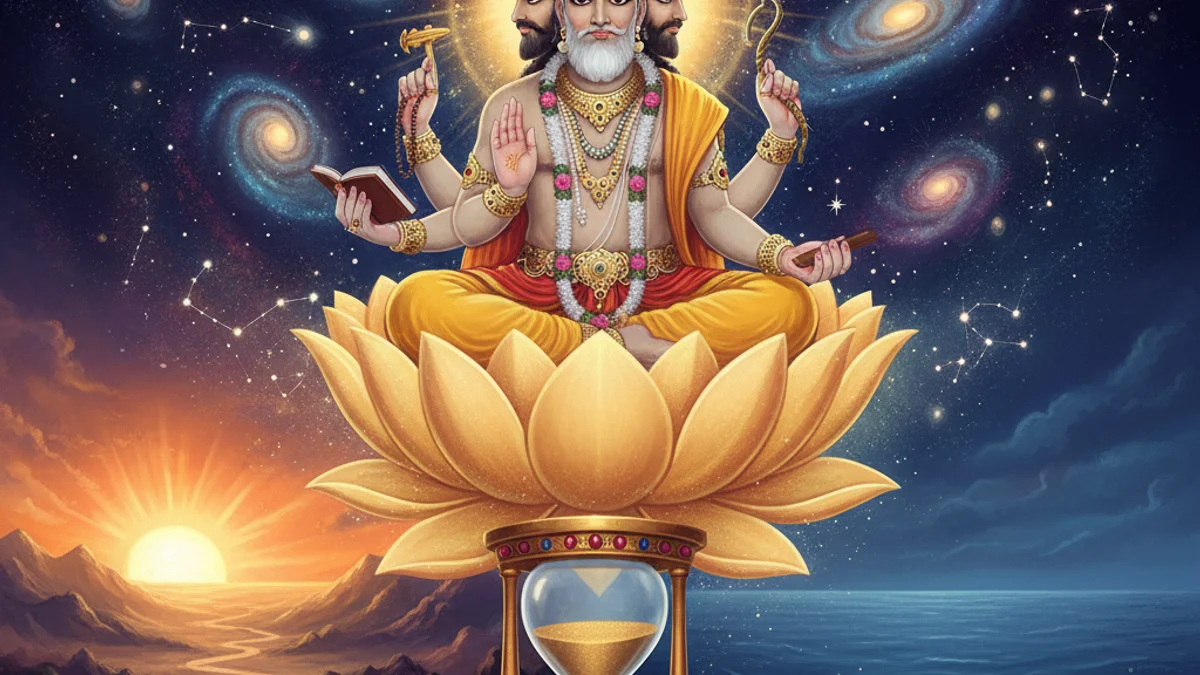
One 'Day of Brahma' (a Kalpa) lasts for 1,000 Maha Yuga cycles, which is approximately 4.32 billion human years—a number remarkably close to the estimated age of the Earth.
Frequently Asked Questions
What is the moral of The Four Yugas?
The moral is that time and morality are cyclical, teaching us that even in the darkest ages, a return to truth and righteousness is inevitable. It encourages resilience and the preservation of personal virtue regardless of the era.
Which Yuga are we currently living in?
According to Hindu tradition, we are currently in the Kali Yuga, which began after the departure of Lord Krishna. It is characterized by a significant decline in spiritual knowledge and an increase in materialism.
How long does a single Maha Yuga cycle last?
A complete cycle of the four Yugas, known as a Maha Yuga, lasts for 4,320,000 human years. Each individual Yuga within the cycle has a specific duration that decreases as the ages progress.
What represents Dharma in the story of the Yugas?
Dharma is often personified as a celestial bull. In the Satya Yuga, it stands on four legs; in Treta on three; in Dvapara on two; and in Kali Yuga, it struggles to balance on just one leg.
Who ends the Kali Yuga?
Prophecy states that at the end of the Kali Yuga, Lord Vishnu will manifest as the Kalki avatar. Riding a white horse with a blazing sword, he will cleanse the world of evil to restart the Satya Yuga.
Why does righteousness decline through the Yugas?
The decline is seen as a natural cosmic process where the purity of the soul is gradually obscured by the material world. This cycle allows for the full experience of creation before the universe resets to its primal, pure state.
Discussion (0)
Share your thoughts on this story
No comments yet. Be the first to share your thoughts!