Story Summary
Rumi's parable The Grapes tells of four men who fight over a coin, only to realize they seek the same fruit. Discover how language creates false divisions.
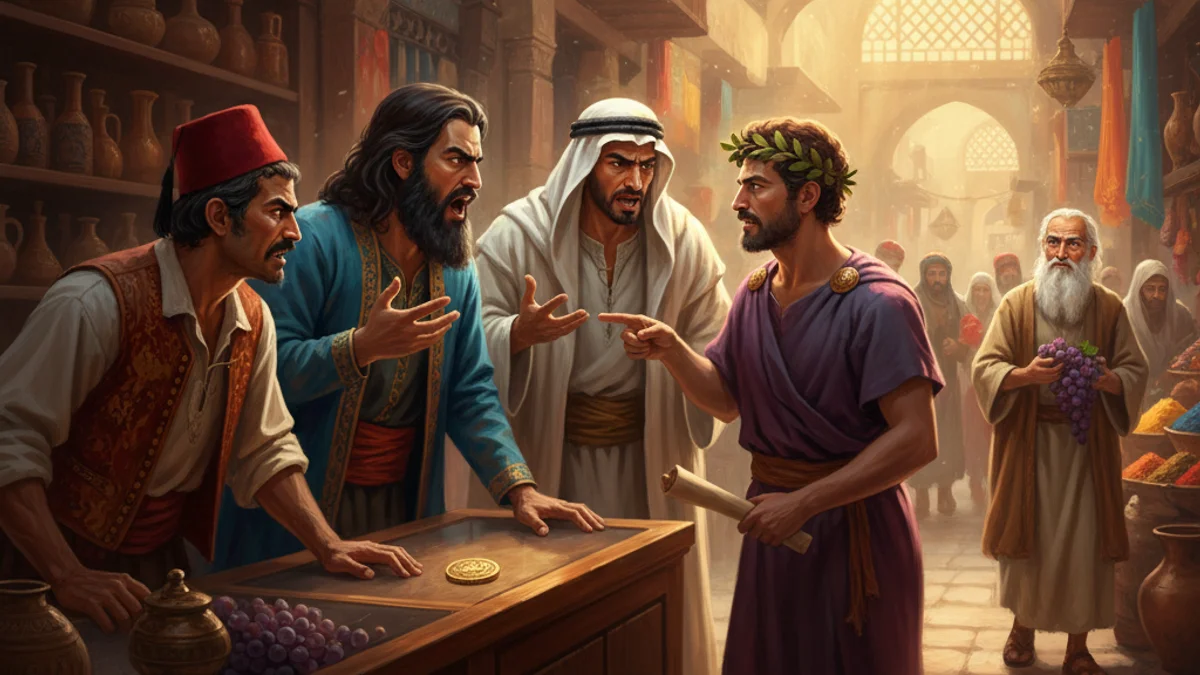
Four travelers—a Persian, an Arab, a Turk, and a Greek—were journeying together when someone gave them a single gold coin. Immediately, a dispute arose over how to spend it. The Persian said, 'I want to buy angur.' The Arab disagreed, shouting, 'No, I want inab!' The Turk insisted, 'I will have nothing but uzum,' while the Greek cried out, 'I demand stafil!' They began to trade insults and blows, each convinced the others were being stubborn and foolish. A wise linguist passing by overheard their quarrel and smiled. He took the coin and went to a nearby market stall, returning shortly with a large, heavy bunch of grapes. Upon seeing the fruit, the Persian's face lit up, 'This is my angur!' The Arab cheered, 'This is my inab!' The Turk and the Greek likewise rejoiced, realizing that while their words were different, their hearts had desired the exact same thing all along. Their conflict had been born of names, not of reality.
The Moral
Conflict often arises from differences in language and labels, even when people are seeking the same ultimate truth.
“The dispute was only over names; the reality was one and the same.”
Fun Fact
This story is part of the Masnavi, which contains over 25,000 verses and is often referred to as the 'Persian Quran' due to its deep spiritual insights.
Frequently Asked Questions
What is the moral of The Grapes?
The moral is that human conflict often stems from linguistic and cultural misunderstandings rather than actual differences in desire or truth. It teaches us to look past labels to find our common ground.
Who wrote the story of The Grapes?
The story was written by Jalal ad-Din Muhammad Rumi, the 13th-century Persian poet and Sufi mystic. It is featured in his monumental work, the Masnavi-ye Ma'navi.
What do the four different names for grapes represent?
The names 'angur,' 'inab,' 'uzum,' and 'stafil' represent the different languages and cultural frameworks people use to describe the same spiritual or physical reality. They symbolize the superficial barriers that lead to unnecessary division.
What is the role of the wise man in the story?
The wise man represents a spiritual teacher or enlightened guide who possesses the 'knowledge of many tongues.' He is able to see the shared essence behind conflicting words and bring peace through understanding.
Why is this story important in Sufism?
In Sufism, it emphasizes the concept of 'Unity of Being,' suggesting that all religions and paths may be seeking the same Divine truth despite using different terminology and rituals.
How can the lesson of The Grapes be applied today?
It serves as a reminder to practice empathy and active listening in modern disputes. By looking beyond the specific words people use, we can often find that our goals and needs are more similar than they appear.
Discussion (0)
Share your thoughts on this story
No comments yet. Be the first to share your thoughts!