Story Summary
Discover the classic Korean folktale of The Green Frog. This story explains why frogs croak in the rain and teaches a powerful lesson about filial piety.
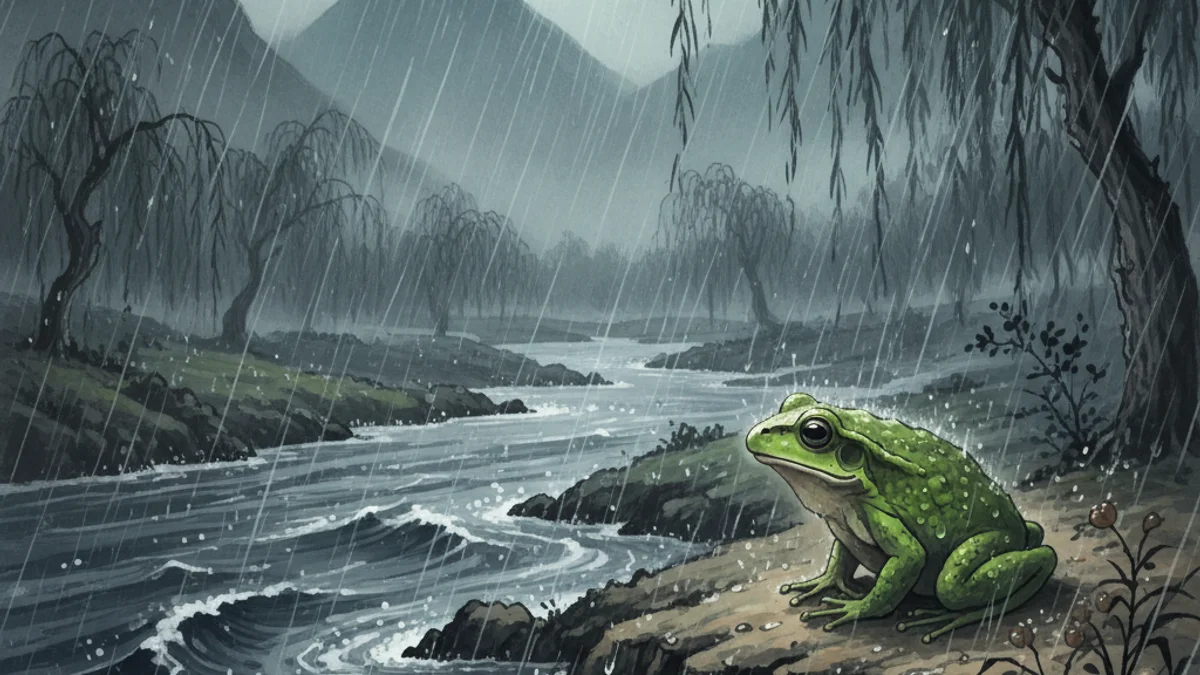
Once, there lived a young green frog who never listened to his mother. If she told him to go to the mountains, he went to the sea. If she told him to croak 'kae-gul,' he would croak 'gul-kae.' Exhausted and nearing death, the mother frog worried about her final resting place. Knowing her son always did the opposite of what she said, she made a clever request: she asked to be buried by the river, hoping he would instead bury her on the sunny hillside. However, overcome with sudden grief and remorse upon her death, the son decided to finally be a good child. He obeyed her last wish literally and buried her right by the riverbank. Now, whenever the sky darkens and it rains, the green frog croaks loudly in sorrow, terrified that the rising waters will wash away his mother's grave.
The Moral
Show respect and obedience to your parents while they are still alive, as regret cannot undo the past once they are gone.
“Kae-gul! Kae-gul! Please do not wash my mother's grave away!”
Fun Fact
In Korea, the term 'Cheonggaeguri' is still widely used today as a playful or scolding nickname for children who act like contrarians.
Frequently Asked Questions
What is the moral of The Green Frog?
The story teaches the importance of filial piety and warns that children should respect their parents' wishes while they are alive to avoid eternal regret.
Why do green frogs cry when it rains in Korean folklore?
According to the legend, they cry because they are worried the rain will cause the river to rise and wash away their mother's grave, which was buried too close to the water.
What does the term 'Cheonggaeguri' mean?
In Korean, 'Cheonggaeguri' means green frog, but it is also a common idiom used to describe a person who is stubbornly disobedient or always does the opposite of what is asked.
Why did the mother frog ask to be buried by the river?
She knew her son always did the opposite of what she said, so she requested the riverbank burial in the hopes that he would defiantly bury her on the hill instead.
Is The Green Frog a popular story in Korea?
Yes, it is one of the most famous didactic folktales in Korea, used for generations to teach children the importance of listening to their elders.
What is the significance of the frog's croak in this tale?
The frog's croak represents a mournful cry of repentance. It symbolizes the voice of someone who realized the value of their parents' wisdom only after it was too late.
Discussion (0)
Share your thoughts on this story
No comments yet. Be the first to share your thoughts!