Story Summary
Discover the classic Aesop fable, The Jay and the Peacock. Learn why vanity and borrowed feathers lead to rejection in this timeless tale about authenticity.
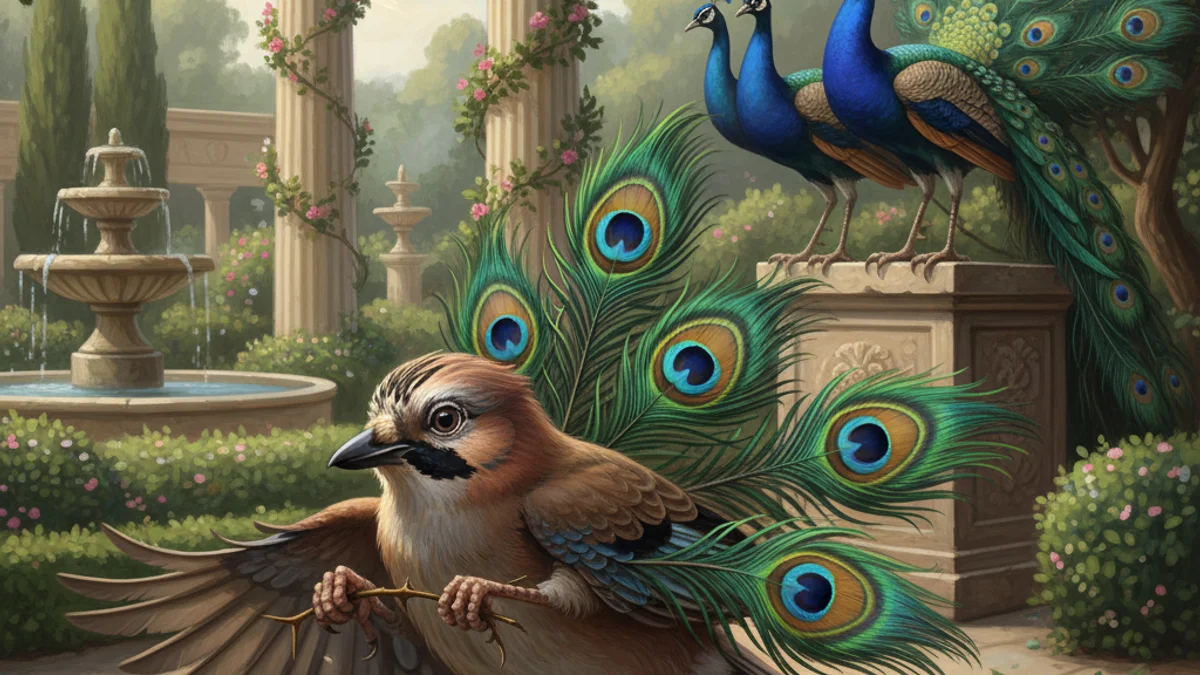
A Jay, puffing himself up with vanity, gathered a bundle of feathers that had fallen from some Peacocks. He stuck them among his own drab plumage and strutted toward a flock of the royal birds, hoping to be mistaken for one of them. The Peacocks, however, instantly detected the cheat. They stripped him of his borrowed finery and pecked him away in derision. When the humbled Jay returned to his own kind, they too refused to associate with him. 'Had you been content with our company,' said one old Jay, 'you would not have suffered the pride of the Peacocks or our present contempt.'
The Moral
It is not only fine feathers that make fine birds; be content with who you are rather than trying to pass as someone you are not.
“It is not only fine feathers that make fine birds.”
Fun Fact
This fable was famously adapted by the Roman fabulist Phaedrus, who used bird imagery to satirize social climbers in ancient Roman society.
Frequently Asked Questions
What is the moral of The Jay and the Peacock?
The moral is that true worth comes from within, not from outward appearances or stolen status. It teaches that trying to be someone you aren't often leads to losing respect from everyone.
Why did the peacocks reject the jay?
The peacocks recognized the jay as an impostor immediately despite the beautiful feathers he wore. They were offended by his deception and punished his vanity by stripping the feathers away and driving him out.
Who wrote the fable of the Jay and the Peacock?
The story is attributed to Aesop, the legendary Greek fabulist. It was later popularized in Latin by the Roman poet Phaedrus, who added his own poetic flair to the tale.
What happens to the jay at the end of the story?
After being cast out by the peacocks, the jay tries to return to his own community. However, his fellow jays reject him as well, disgusted by his earlier arrogance and his attempt to abandon his own kind.
What does the phrase 'borrowed feathers' mean?
The phrase refers to someone who takes credit for things they didn't earn or pretends to have qualities they lack. It is a direct reference to this fable's warning against intellectual or social dishonesty.
Is this story the same as 'The Vain Jackdaw'?
They are very similar and often considered variations of the same fable. In some versions, the bird is a jackdaw rather than a jay, but the plot involving fallen feathers and social rejection remains the same.
Discussion (0)
Share your thoughts on this story
No comments yet. Be the first to share your thoughts!