Story Summary
Experience the poignant tale of The Little Match Girl, a shivering child whose visions bring warmth and hope on a freezing New Year's Eve in this classic fable.
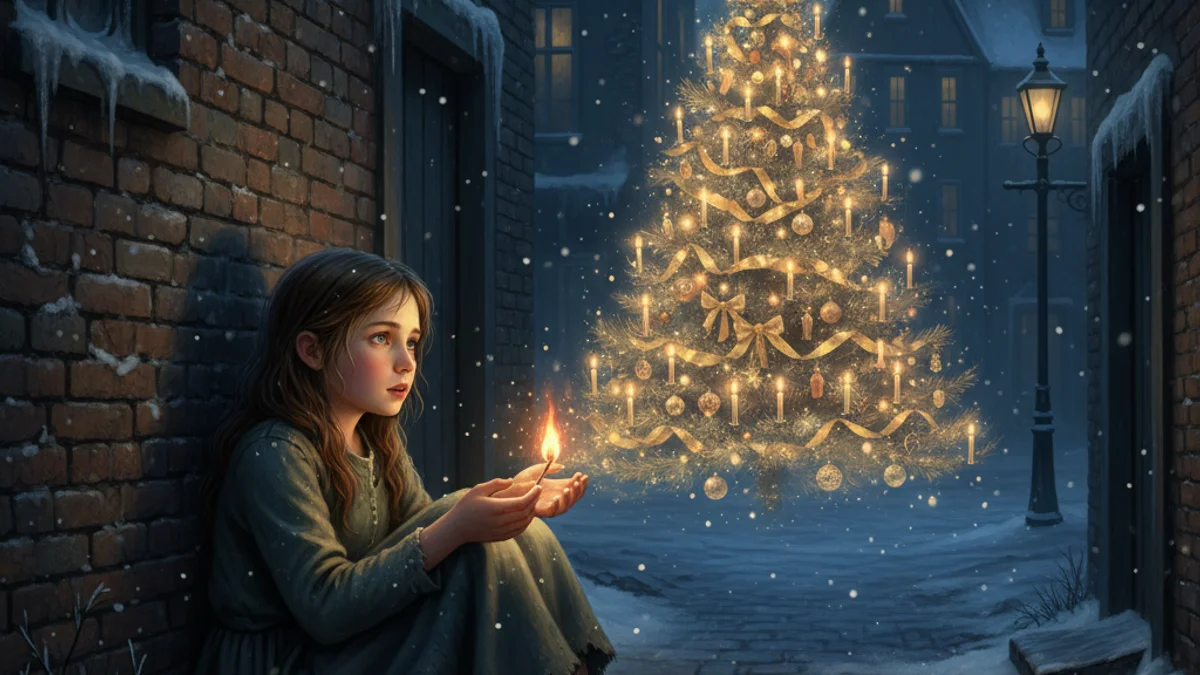
On a freezing New Year's Eve, a poor young girl wandered the snowy streets, her bare feet blue with cold. She had not sold a single bundle of matches all day and dared not go home to her father without a penny, for fear of a beating. Seeking a moment of warmth, she huddled in a corner between two houses and struck a match. In its brief glow, she saw a magnificent iron stove, but it vanished as the flame died. She struck another, revealing a festive table laden with a roasted goose. A third match showed a shimmering Christmas tree decorated with thousands of lights. Finally, she saw her late grandmother, the only person who had ever been kind to her. To keep her grandmother there, she struck the entire rest of the bundle. Her grandmother took the girl in her arms, and they both flew upward in light and joy, far above the earth where there is no cold or hunger. The next morning, the townspeople found the girl frozen with a smile on her lips, never knowing the beautiful things she had seen.
The Moral
The story serves as a powerful call for social compassion and charity toward the suffering and neglected.
“When a star falls, a soul goes up to God.”
Fun Fact
Hans Christian Andersen wrote this story partly as a tribute to his mother, who was forced to go out and beg as a young child in the freezing cold.
Frequently Asked Questions
What is the moral of The Little Match Girl?
The story serves as a tragic reminder to show compassion and charity toward the poor. It highlights the invisible suffering of children living in poverty during festive times when others are celebrating.
Who wrote The Little Match Girl?
The story was written by the famous Danish author Hans Christian Andersen. It was first published in 1845 and has since become one of his most famous and heart-wrenching works.
What do the matches symbolize in the story?
The matches symbolize hope and the fleeting nature of comfort. Each match provides a brief, beautiful vision of the things the girl lacks—warmth, food, joy, and love—before reality returns.
Does The Little Match Girl have a happy ending?
While the girl dies of cold, the ending is bittersweet. Andersen portrays her death as a peaceful escape from a cruel world, as she is reunited with her loving grandmother in heaven.
What are the visions the girl sees?
She sees four distinct visions: a warm iron stove, a delicious roasted goose on a festive table, a magnificent Christmas tree, and finally, her deceased grandmother.
Why is the story set on New Year's Eve?
The setting creates a sharp contrast between the cold, lonely reality of the girl and the warmth and abundance of the families celebrating inside their homes, emphasizing social inequality.
Discussion (0)
Share your thoughts on this story
No comments yet. Be the first to share your thoughts!