Story Summary
Discover The Master and the Student, a classic Japanese samurai legend about Matajuro Yagyu’s journey from an impatient youth to a legendary master of Bushido.
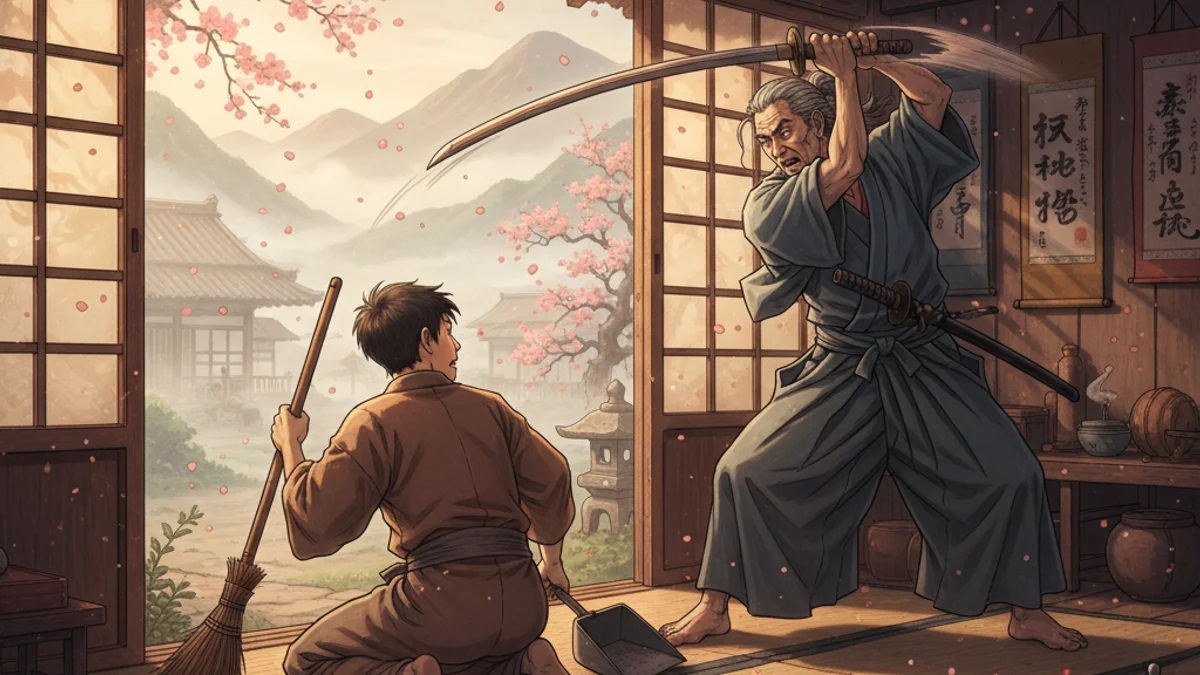
Matajuro Yagyu was the son of a famous swordsman, but his father disowned him, believing he lacked the talent to ever master the blade. Seeking to prove his worth, Matajuro traveled to Mount Futara to find the legendary master Banzo. When Matajuro asked how long it would take to become a master, Banzo replied, 'Ten years.' Impatient, Matajuro asked how long it would take if he worked twice as hard. Banzo frowned and said, 'Twenty years.' Distraught, Matajuro promised to devote every waking second to the art. Banzo sighed and said, 'In that case, thirty years.' Matajuro finally understood that his impatience was his greatest obstacle. He agreed to stay, but for three years, Banzo forbade him from even touching a sword. Instead, Matajuro was forced to cook, clean, and garden. One day, while Matajuro was cooking, Banzo crept up and struck him with a wooden sword. From that moment on, the master attacked him day and night, during sleep and chores. To survive, Matajuro had to develop a state of constant, effortless awareness. Only when his mind was perfectly still and ready for any blow did Banzo finally begin to teach him the secrets of the blade. Matajuro had become a master before he ever drew his sword.
The Moral
True mastery is not found in technical haste, but in the cultivation of a patient, disciplined, and ever-present mind.
“When you have one eye on the destination, you have only one eye on the path.”
Fun Fact
The Yagyu Shinkage-ryu school of swordsmanship, featured in this legend, became so prestigious that its masters were the personal sword-fighting instructors for the Tokugawa Shogunate for centuries.
Frequently Asked Questions
What is the moral of The Master and the Student?
The moral is that obsession with a goal can distract from the necessary growth of the journey. Patience and mindfulness are the foundations of true skill.
Why did the Master increase the training time when Matajuro said he would work harder?
The master wanted to show that impatience and ego create mental blocks. When one eye is fixed on the destination, only one eye remains to navigate the path, making progress twice as slow.
What does 'Mushin' mean in the context of this story?
Mushin, or 'no-mind,' is the state of awareness Matajuro achieved by being forced to defend against surprise attacks. It is a mental state where the mind is not fixed on any thought or emotion, allowing for pure instinct.
Was Matajuro Yagyu a real person?
Yes, Matajuro was a member of the famous Yagyu clan, a family of swordsmen who served as the official instructors to the Tokugawa Shoguns. This story is a legendary account of his training.
Why was Matajuro not allowed to touch a sword for three years?
The master wanted to break Matajuro's ego and impatience. By doing menial tasks, he learned humility and the discipline required to serve something greater than his own ambition.
What is the significance of the wooden sword (bokken)?
The wooden sword represents the transition from physical violence to mental discipline. It shows that the lesson is about the mind's reaction and awareness rather than the lethality of the weapon.
Discussion (0)
Share your thoughts on this story
No comments yet. Be the first to share your thoughts!