Story Summary
In The Mice in Council, a group of mice devises a clever plan to bell a cat, only to realize that ideas are useless without someone brave enough to act.
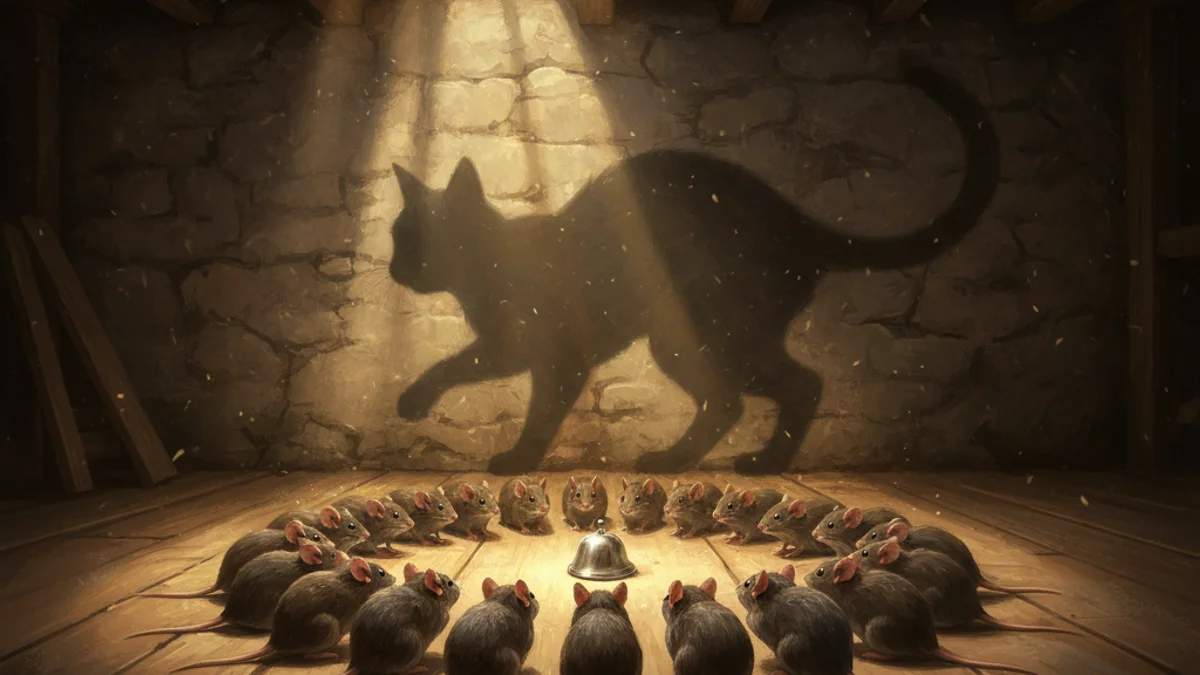
For years, a community of mice lived in constant terror of a sleek, silent cat that stalked their every move. One evening, they convened a council to find a permanent solution to their peril. After many failed suggestions, a young mouse stood up with a flourish. 'I have a brilliant plan!' he cried. 'We shall hang a small bell around the cat's neck. Its tinkling will warn us of his approach, giving us plenty of time to scurry to safety.' The mice erupted in cheers, dancing and applauding the genius of the idea. However, a wise old mouse, who had remained silent in the corner, finally spoke. 'The plan is indeed clever,' he said slowly. 'But tell me, which of us is going to bell the cat?' The room fell into a heavy, suffocating silence as each mouse looked at the floor, realizing that a good plan is worthless if it cannot be executed.
The Moral
It is easy to propose impossible remedies; the value of a plan lies entirely in its execution.
“It is one thing to say that something should be done, but quite a different matter to do it.”
Fun Fact
The story was used in Scottish history when Archibald Douglas, 5th Earl of Angus, earned the nickname 'Bell-the-Cat' after leading a group to remove a royal favorite.
Frequently Asked Questions
What is the moral of The Mice in Council?
The moral is that it is easy to suggest grand solutions, but much harder to carry them out. It highlights the difference between theoretical planning and practical execution.
What does the phrase 'belling the cat' mean today?
It refers to a task that is agreed upon by a group but is so dangerous or difficult that no one is willing to actually perform it. It is a common idiom in business and politics.
Who is the original author of this fable?
The story is attributed to Aesop, the ancient Greek storyteller. It has been retold throughout history by various fabulists, including Jean de La Fontaine and Odo of Cheriton.
Why is the old mouse's role significant?
The old mouse represents wisdom and realism. While the young mouse focuses on the 'what,' the old mouse focuses on the 'how,' exposing the fatal flaw in the plan.
Did the mice ever succeed in their plan?
In traditional versions of the fable, the mice never bell the cat. The story ends with their silence, emphasizing that the problem remains unsolved due to a lack of courage and practicality.
What is the origin of the 'belling the cat' idiom?
The phrase originated from this specific fable. It became particularly popular in English literature after appearing in William Langland’s 14th-century poem, 'Piers Plowman.'
Discussion (0)
Share your thoughts on this story
No comments yet. Be the first to share your thoughts!