Story Summary
Experience The Miller's Tale, a classic medieval fabliau where a carpenter is duped by a clever clerk, leading to a hilarious and chaotic night of mischief.
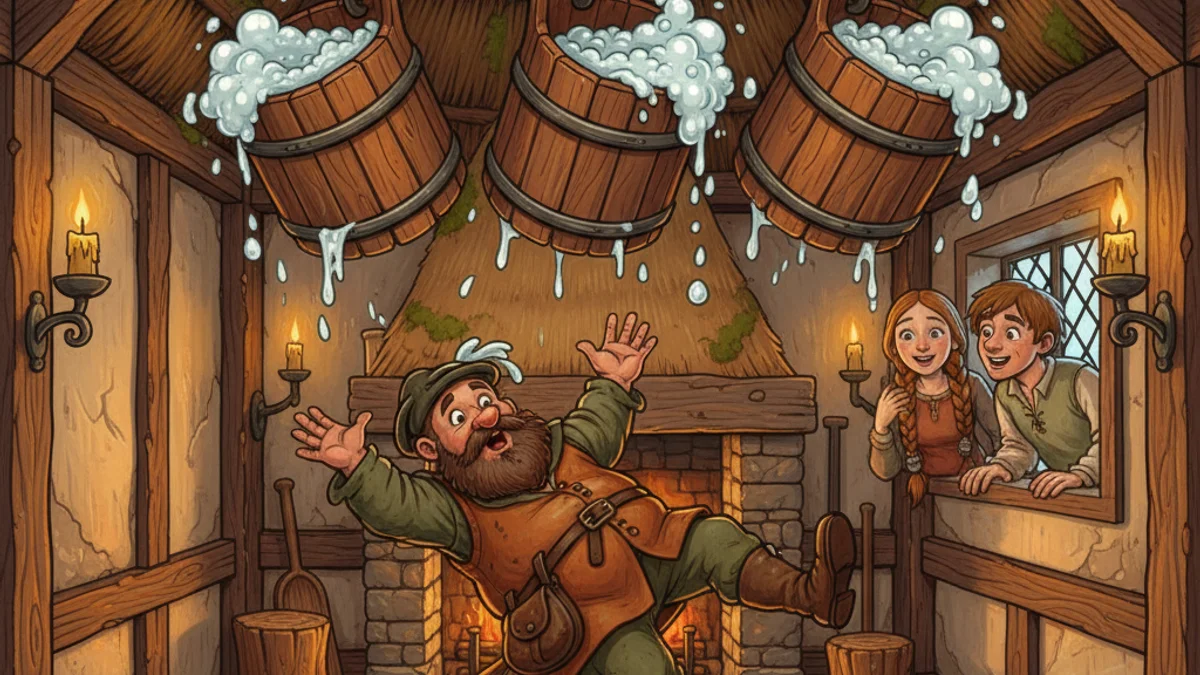
In the town of Oxford lived a wealthy, jealous carpenter named John, who had a beautiful young wife named Alison. Boarding with them was Nicholas, a clever student of astrology. Nicholas and Alison began a secret affair, but to find time together, they needed to get John out of the way. Nicholas convinced the gullible carpenter that a second Great Flood was coming, far worse than Noah’s. He instructed John to hang three large kneading tubs from the ceiling rafters, stocked with bread and ale, where they would wait for the waters to rise. On the appointed night, John climbed into his tub and quickly fell into a deep sleep. Nicholas and Alison then climbed down and spent the night together. Meanwhile, Absolon, a local parish clerk also infatuated with Alison, came to the window begging for a kiss. Tired of his pestering, Alison stuck her rear out the window in the dark, and Absolon kissed it. Enraged by the humiliation, Absolon returned with a red-hot coulter. When he asked for another kiss, Nicholas stuck his own rear out to mock him. Absolon branded him with the iron, and Nicholas screamed, 'Water! Help!' Hearing the cry, John woke up, thought the flood had arrived, and cut the ropes holding his tub. He crashed to the floor, breaking his arm, and when he tried to explain the flood to the neighbors, they only laughed at his madness.
The Moral
Jealousy and mismatched marriages often invite folly, and those who plot elaborate tricks frequently find themselves the victims of their own schemes.
“And thus the carpenter's wife was kissed, and John was made the fool of the town.”
Fun Fact
Chaucer’s Miller tells this crude story specifically to 'quite' or match the Knight’s Tale, subverting the previous story's themes of courtly love with slapstick comedy.
Frequently Asked Questions
What is the moral of The Miller's Tale?
The moral highlights the dangers of jealousy and the folly of mismatched unions. It also suggests that cleverness used for deception often results in shared humiliation for everyone involved.
Who wrote The Miller's Tale?
The story was written by Geoffrey Chaucer as part of 'The Canterbury Tales' in the late 14th century. It is told by the Miller to follow the Knight's more noble story.
What is a fabliau in medieval literature?
A fabliau is a short, humorous, and often bawdy poetic tale popular in medieval France and England. These stories typically feature trickery, infidelity, and lower- or middle-class characters.
Why did John hang tubs from the ceiling?
Nicholas convinced the gullible John that a second Great Flood was imminent. He claimed the tubs would act as personal boats to keep them safe until the waters subsided.
How does Absolon get revenge in the story?
After being tricked into kissing Alison's rear, Absolon returns with a red-hot iron from a blacksmith. He uses it to brand Nicholas when the student tries to repeat the prank.
What happens to the carpenter at the end?
John wakes up, cuts the ropes of his tub, and falls to the ground, breaking his arm. His neighbors believe he has gone mad, and he becomes the laughingstock of the town.
Discussion (0)
Share your thoughts on this story
No comments yet. Be the first to share your thoughts!