Story Summary
Explore the ancient Egyptian myth of The Primeval Mound. Witness how the Benben rose from the waters of Nun to become the sacred foundation of all existence.
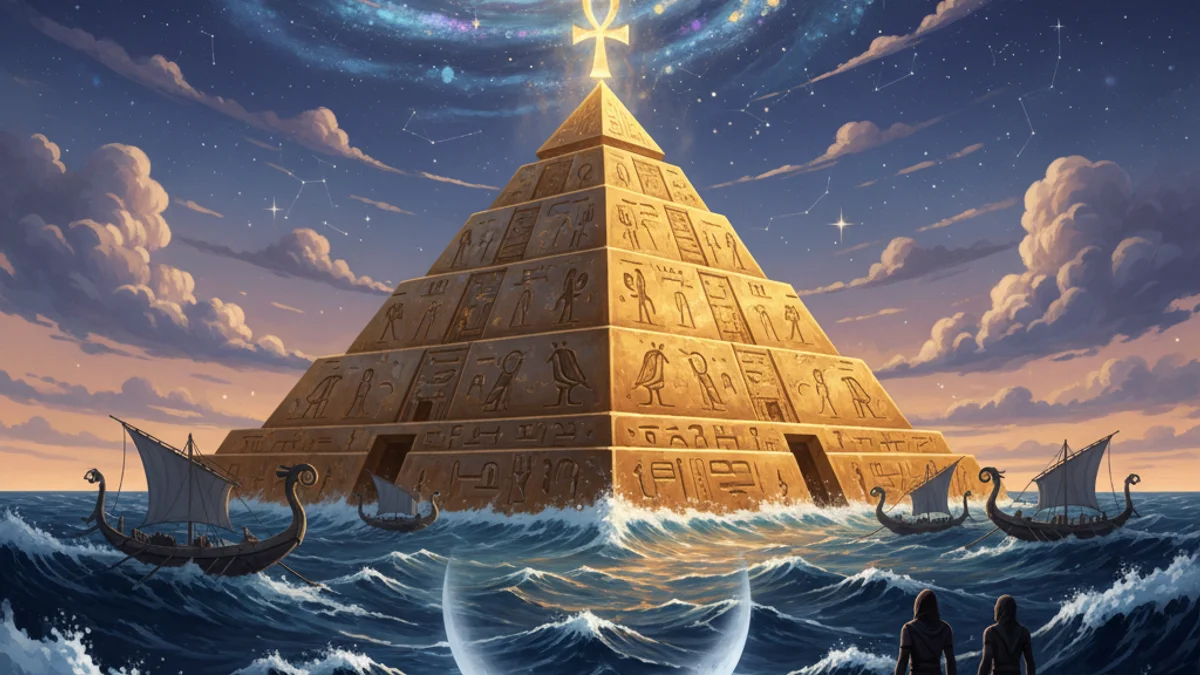
Before time began, there was only Nun—a dark, silent, and infinite abyss of primordial water. Within these chaotic depths lay the potential for all life, yet nothing had form. From this watery void, a spark of divine will stirred. It was Atum, the All-Father, who willed himself into existence. Seeking a place to stand amidst the shifting currents, Atum caused the first solid earth to rise from the depths. This was the Benben, the Primeval Mound. As this golden hill broke the surface, the first dawn illuminated the cosmos. Standing upon this sacred foundation, Atum looked out at the stillness and began the process of naming the world into being, transforming the chaos of Nun into the ordered beauty of the universe.
The Moral
From the depths of chaos and uncertainty, order and purpose can emerge through a single act of will.
“Out of the infinite silence of the deep, the first light bloomed upon the first stone.”
Fun Fact
The pointed capstones placed at the very top of pyramids and obelisks were called pyramidions, or Benbenet, named directly after the original Primeval Mound.
Frequently Asked Questions
What is the moral of The Primeval Mound?
The story teaches that even in total chaos, a single point of stability and will can bring forth a structured world. It emphasizes that every great creation begins with a small, solid foundation.
What is the Benben stone in Egyptian mythology?
The Benben stone is the sacred representation of the Primeval Mound. It is often depicted as a pyramid-shaped stone that symbolized the first land to emerge from the waters of creation.
Which god created the Primeval Mound?
In the Heliopolitan tradition, the god Atum is the creator who willed himself into being and brought forth the mound. Other traditions sometimes credit Ra, Ptah, or Amun with this foundational act of creation.
Why is the Primeval Mound important to pyramids?
The shape of the Egyptian pyramids was inspired by the Primeval Mound. They were designed to look like the Benben stone, serving as a symbolic link between the earthly pharaoh and the divine light of the first creation.
What were the waters of Nun?
Nun was the personification of the primordial, watery abyss that existed before the world. It represented the state of chaos and potential that preceded the birth of the gods and the physical universe.
Does every Egyptian creation story include the mound?
Yes, while the names of the gods may change between cities like Memphis and Thebes, the concept of a primeval hill rising from the water is a consistent theme across almost all Egyptian creation myths.
Discussion (0)
Share your thoughts on this story
No comments yet. Be the first to share your thoughts!