Story Summary
Discover the legend of Minamoto no Raiko in The Samurai and the Spider, a classic tale of Bushido courage, supernatural mystery, and the famous sword Kumokiri.
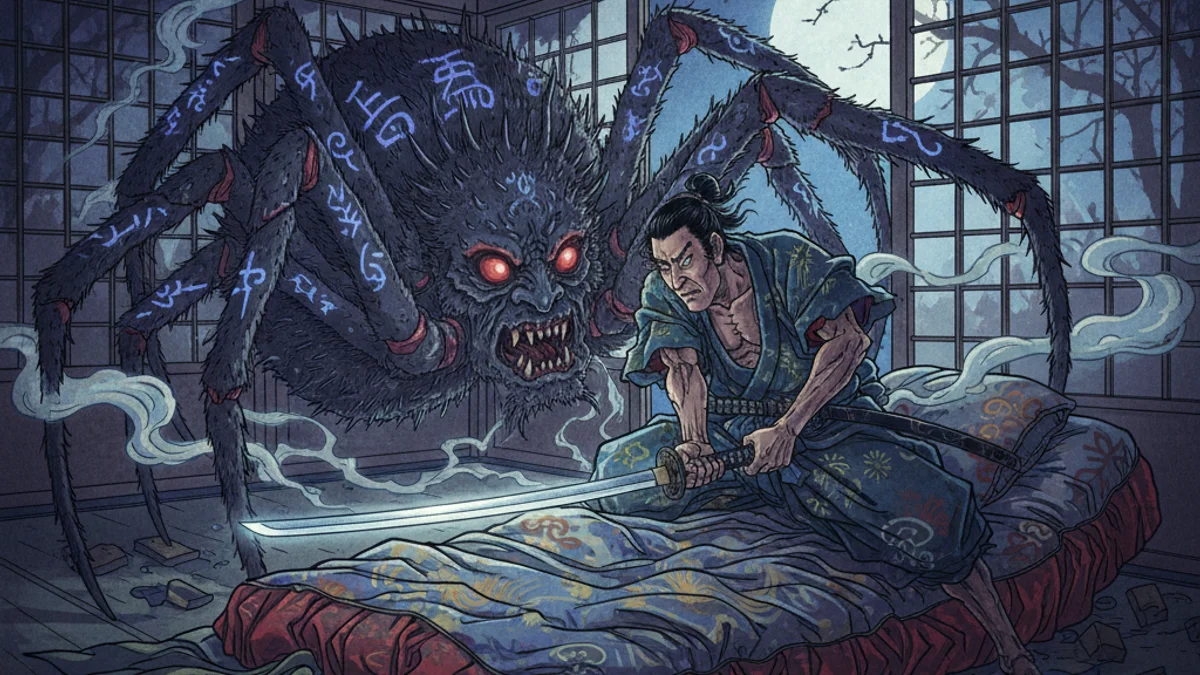
Minamoto no Yorimitsu, the legendary hero known as Raiko, lay stricken with a mysterious and debilitating fever. As he rested in his darkened chambers, a strange monk appeared from the shadows, towering over the weakened warrior. The monk cast a shimmering web of binding silk over Raiko, revealing his true form as the Tsuchigumo, a monstrous Earth Spider. Despite his illness, Raiko’s samurai instincts remained sharp. He lunged from his futon, drawing his prized sword and slashing at the beast. The creature fled, leaving a trail of dark blood. Raiko’s loyal retainers followed the trail to a deep cavern in the mountains, where they discovered a giant spider-demon. They slew the monster, and as it died, Raiko’s fever instantly vanished. His blade, having tasted the blood of the supernatural, was renamed Kumokiri—the Spider-Cutter.
The Moral
True strength of spirit and constant vigilance can overcome even the most overwhelming threats, even when one is at their physically weakest.
“Though my body is weakened by fever, my blade remains the sharp edge of my soul.”
Fun Fact
The sword Kumokiri (Spider-Cutter) is one of the most famous blades in Japanese mythology and is often featured in Kabuki theater and Ukiyo-e woodblock prints.
Frequently Asked Questions
What is the moral of The Samurai and the Spider?
The moral is that a warrior's spirit and vigilance are his greatest weapons. It teaches that internal strength and readiness can triumph over external deception and physical frailty.
Who was Minamoto no Raiko?
Minamoto no Yorimitsu, also known as Raiko, was a real historical figure from the Heian period who became a legendary hero in Japanese folklore for hunting supernatural monsters.
What is a Tsuchigumo?
A Tsuchigumo is a mythical Japanese yokai or 'earth spider.' In legends, they are often depicted as giant, shapeshifting spiders that represent chaos or rebellion against the Emperor.
What happened to Raiko's sword after the battle?
Originally named Hizamaru, the sword was renamed Kumokiri, meaning 'Spider-Cutter,' to commemorate Raiko's victory over the monstrous Tsuchigumo.
Is The Samurai and the Spider a true story?
While Minamoto no Raiko was a real person, the story is a legend. Historians believe the 'spiders' were likely metaphorical representations of local clans who resisted the central government's authority.
Why was Raiko sick in the story?
Raiko's illness was caused by the supernatural influence of the Tsuchigumo. In folklore, monsters often used magic or poison to weaken great heroes before attacking them.
Discussion (0)
Share your thoughts on this story
No comments yet. Be the first to share your thoughts!