Story Summary
Explore the legend of The Six-Eared Macaque, the cunning doppelgänger who challenged Sun Wukong's identity in this epic tale from the classic Journey to the West.
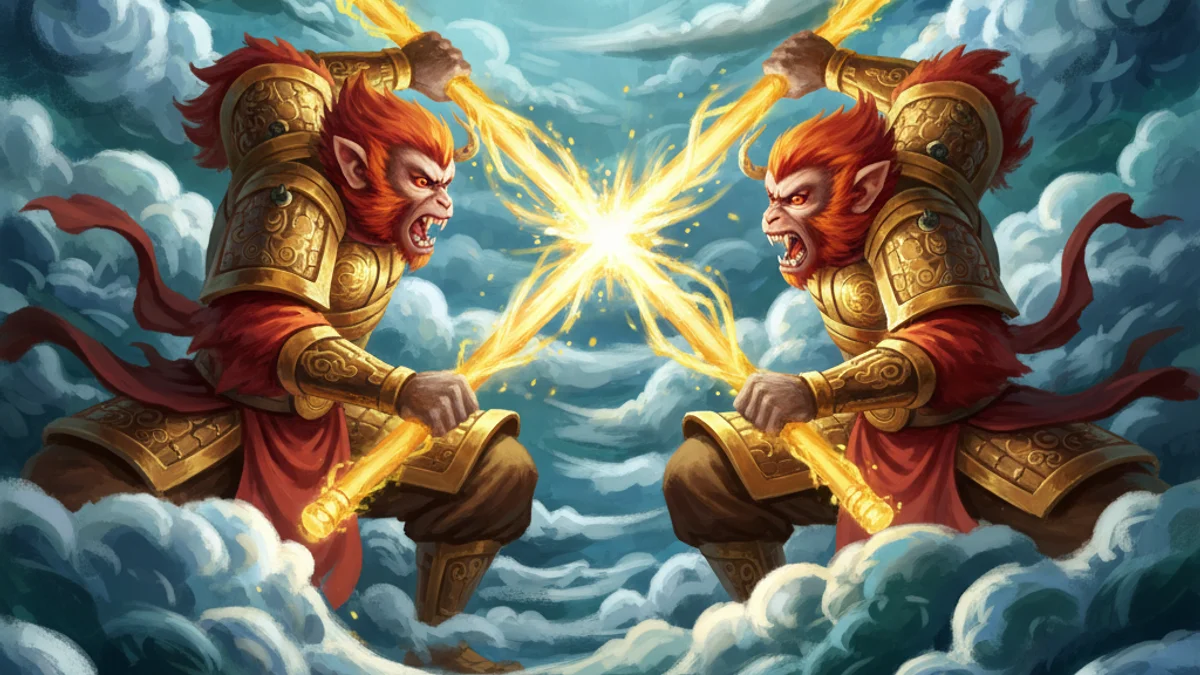
During their journey to the West, a rift formed between Sun Wukong and Tang Sanzang after the Monkey King killed a group of bandits. Exploiting this discord, an impostor appeared who looked, spoke, and fought exactly like Wukong. This was the Six-Eared Macaque, a creature of immense power who possessed the ability to hear the past and future. The two monkeys engaged in a titanic battle that spanned the heavens and the earth, yet no one could tell them apart. Even the Bodhisattva Guanyin and the celestial mirrors of the Jade Emperor failed to distinguish the true Monkey King from the fake. They traveled to the Underworld, but the Truth-Listener beast, while sensing the truth, feared to speak it. Finally, they sought the Buddha at Leiyin Temple. With a flick of his fingers, the Buddha revealed the impostor's true nature: a primordial macaque capable of mimicking all things. Trapped under a golden bowl, the Six-Eared Macaque was exposed, and Sun Wukong, in a fit of righteous fury, struck him down, reclaiming his rightful place at his master's side.
The Moral
True identity and merit come from one's inner character and devotion, not merely from outward appearance or mimicry.
“The Buddha sees through the mask that blinds even the gods.”
Fun Fact
In Chinese literary theory, the chapter featuring the Six-Eared Macaque is often titled 'Two Minds Cause Turmoil in the Universe,' suggesting the two monkeys are two halves of one soul.
Frequently Asked Questions
What is the moral of The Six-Eared Macaque?
The story teaches that while appearances can be perfectly imitated, one's true essence and history of growth cannot. It also serves as a warning against the 'two minds' or internal conflict that can derail a person's spiritual journey.
Who is the Six-Eared Macaque?
He is one of the four spiritual primates who do not belong to the ten categories of living beings. He has the power to hear everything from thousands of miles away and can perfectly mimic any being's powers and appearance.
How did the Buddha identify the real Sun Wukong?
The Buddha used his supreme wisdom to identify the Macaque as one of the four 'World-Muddling Primates.' He then trapped the impostor under a giant golden bowl, stripping away his disguise and revealing his six ears.
Is the Six-Eared Macaque actually Sun Wukong's evil side?
In many literary interpretations, the Macaque represents Sun Wukong's 'Second Mind' or his negative impulses. His appearance occurs right after a major falling out between Wukong and his master, symbolizing internal struggle.
Why couldn't the Mirror of Heaven identify the impostor?
The Six-Eared Macaque was so perfect in his mimicry that he shared the same physical essence and magical aura as Sun Wukong. Only those with absolute spiritual enlightenment, like the Buddha, could see the subtle difference.
What happened to the Six-Eared Macaque at the end?
After the Buddha exposed his true identity and trapped him, Sun Wukong immediately killed the Macaque with his Golden Cudgel to prevent him from causing further chaos or attempting to steal the scriptures.
Discussion (0)
Share your thoughts on this story
No comments yet. Be the first to share your thoughts!