Story Summary
Discover the Zen story The Sound of One Hand, where a young monk seeks the truth behind a famous koan to transcend intellectual thought and find inner silence.
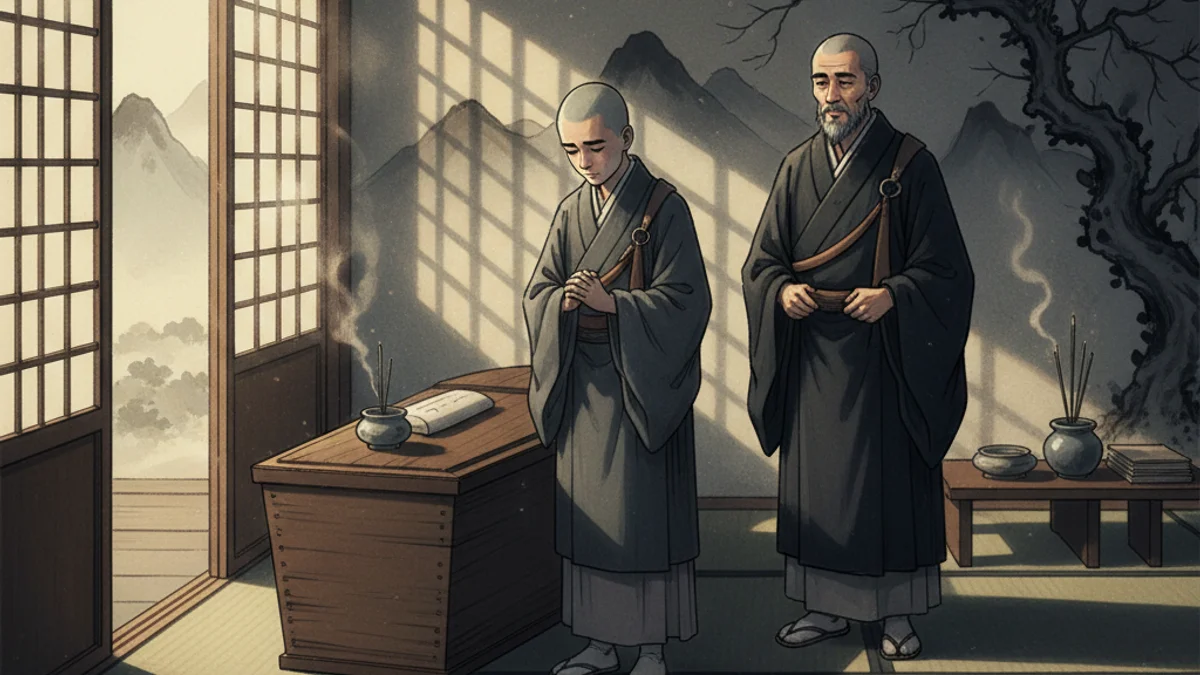
Toyo was a young novice at the Kennin temple. He saw the older students interviewing with the master, Mokura, who gave them koans to solve. Toyo pleaded to be taught, and finally, Mokura agreed. 'You can hear the sound of two hands when they clap together,' said Mokura. 'Now show me the sound of one hand.' Toyo bowed and went to his room to consider this problem. From his window, he heard the music of the geishas. 'I have it!' he proclaimed. The next day, he imitated the sound of the geisha's music for his master. 'No, no,' said Mokura. 'That is not the sound of one hand.' Toyo then tried the sound of dripping water, the sighing of the wind, the cry of an owl, and even the buzzing of a locust. Each time, Mokura rejected his answer. For a year, Toyo meditated on every possible sound, but none were the true answer. Finally, he entered a state of deep meditation and transcended all sounds. He reached the place where no sound exists. 'I have found it,' he realized. When he returned to the master, he did not make a sound at all; he simply bowed. He had finally grasped the sound of one hand.
The Moral
True wisdom and enlightenment cannot be found through intellectual logic or sensory imitation, but through transcending the dualistic mind.
“You can hear the sound of two hands when they clap together. Now show me the sound of one hand.”
Fun Fact
This koan is one of the most famous in the world and was specifically designed by Master Hakuin to be more effective for beginners than older, more complex riddles.
Frequently Asked Questions
What is the moral of The Sound of One Hand?
The story teaches that spiritual truth is found beyond the limits of logic and the five senses. It emphasizes that enlightenment comes from inner stillness rather than external searching.
What is a Zen koan?
A koan is a paradoxical anecdote or riddle used in Zen Buddhism to demonstrate the inadequacy of logical reasoning and to provoke enlightenment.
Who created The Sound of One Hand koan?
This specific koan was created by the 18th-century Japanese Zen master Hakuin Ekaku as a way to focus the minds of his students.
Why did the master reject the sounds Toyo brought him?
The master rejected the sounds because they were all 'external' noises that Toyo had observed in the world. The master wanted Toyo to find a truth that exists beyond the physical world of sound.
Is there a correct verbal answer to the sound of one hand?
In Zen tradition, there is no single 'correct' word or sound; the answer is a realization of non-duality that is often expressed through silence or a spontaneous action.
What does the 'one hand' represent in Zen Buddhism?
The 'one hand' represents the absolute, the non-dual state of existence where there is no separation between the self and the universe.
Discussion (0)
Share your thoughts on this story
No comments yet. Be the first to share your thoughts!