Story Summary
Discover the classic Japanese folktale of The Stonecutter, a man who seeks ultimate power only to realize his true worth. A timeless lesson on contentment.
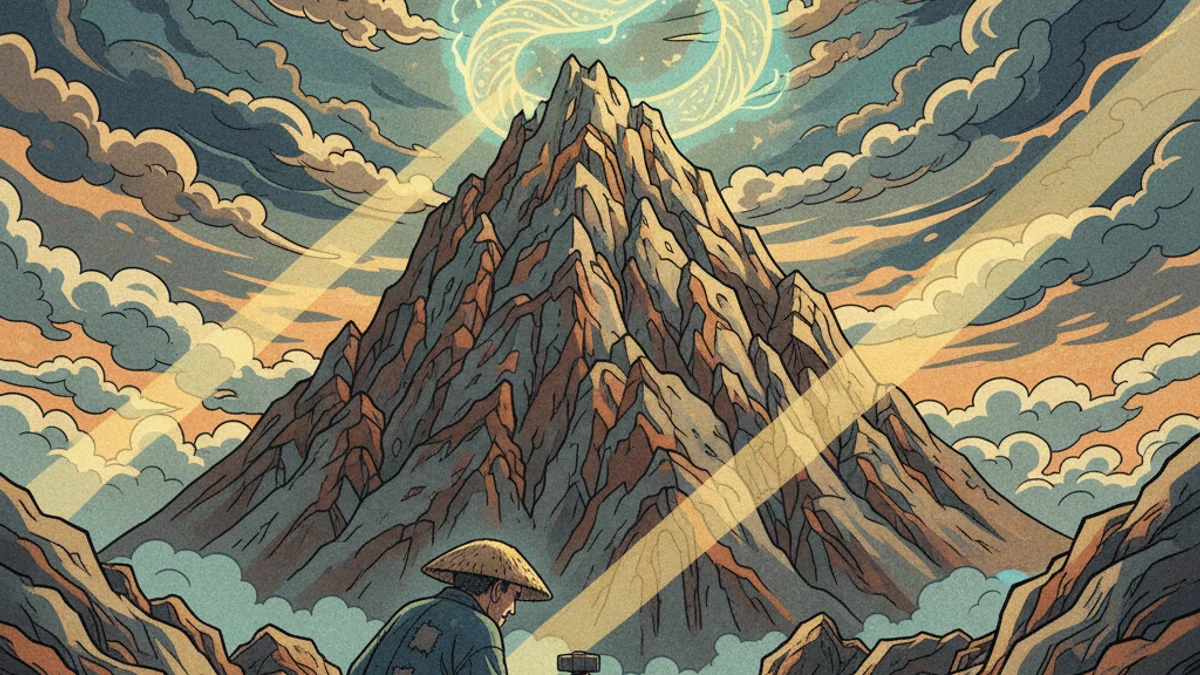
In ancient Japan, a humble stonecutter worked daily against the mountain, his muscles aching and his skin bronzed by the sun. One day, a wealthy prince passed by in a golden palanquin. 'How I wish to be a prince,' the stonecutter sighed. A mountain spirit heard him and transformed him instantly. As a prince, he felt powerful until the sun scorched him. 'The sun is greater than I,' he cried, and he became the sun. But a cloud covered his light, and he wished to be the cloud. As a cloud, he poured rain until the wind blew him away. He became the wind, howling with might, until he struck a mountain that would not move. 'The mountain is the strongest!' he shouted, becoming the stone itself. He stood tall and unyielding until he felt a sharp, rhythmic sting at his feet. A lowly stonecutter was chipping away his foundation. Realizing his original self held the ultimate power, he wished one final time to be himself again, content at last with his chisel and hammer.
The Moral
True power and contentment come from accepting yourself rather than constantly seeking to be something else.
“Nothing is more powerful than the hand that shapes the earth.”
Fun Fact
This tale was famously adapted by the Dutch author Multatuli in his 1860 novel 'Max Havelaar,' which helped bring the Japanese legend to a global audience.
Frequently Asked Questions
What is the moral of The Stonecutter?
The story teaches that everyone has a unique place and power in the world, and true happiness comes from self-acceptance. It warns against the endless cycle of greed and the illusion of superior power.
Who is the mountain spirit in the story?
In many versions of this Japanese tale, the mountain spirit is a benevolent or mystical entity that grants the stonecutter’s wishes. It acts as a catalyst for the protagonist's journey of self-discovery and transformation.
What are the stonecutter's transformations?
He begins as a stonecutter, then becomes a wealthy man, a prince, the sun, a rain cloud, a powerful wind, and finally a mountain. Each transformation reveals a new weakness, leading him back to his original form.
Is The Stonecutter a Japanese or Chinese folk tale?
While variations of this story exist in several East Asian cultures, it is most famously documented as a classic Japanese folktale. It was popularized in the West by writers like Lafcadio Hearn and Dutch author Multatuli.
What does the mountain symbolize in the story?
The mountain represents the pinnacle of strength and endurance, appearing immovable and invincible. However, it also symbolizes the irony that even the greatest entities can be changed by the smallest, most persistent forces.
Why does the stonecutter want to be a stonecutter again?
He realizes that even as a mighty mountain, he is at the mercy of the stonecutter's tools. This epiphany shows him that his original life held a power that even the elements could not overcome.
Discussion (0)
Share your thoughts on this story
No comments yet. Be the first to share your thoughts!