Story Summary
Discover The Story of Ajamila from the Bhagavata Purana, a powerful tale of redemption where chanting the name of Narayana saves a sinner from the messengers of death.
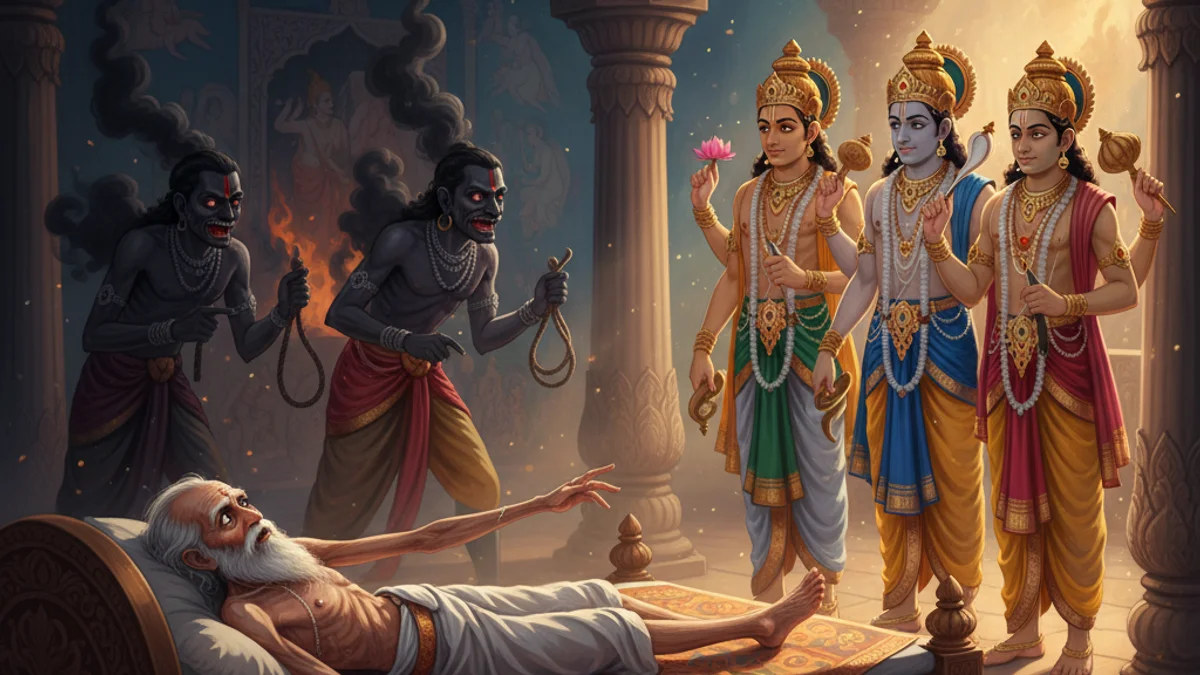
Ajamila was once a virtuous Brahmin, dedicated to his duties and scripture. However, his life took a drastic turn when he witnessed a scene of intoxication and lust, causing him to abandon his pious wife and family for a woman of ill-repute. For years, he lived a life of vice, theft, and sin to support his new family. In his old age, he had a young son whom he named Narayana. He became so attached to the boy that he constantly called out his name. As Ajamila lay on his deathbed, the terrifying Yamadutas, messengers of the god of death, appeared to drag his soul to hell. Terrified, Ajamila cried out for his youngest son: 'Narayana!' Instantly, the radiant Vishnudutas, messengers of Lord Vishnu, descended and blocked the path of death. They argued that because Ajamila had uttered the holy name of the Lord at the moment of death—even if he intended to call his son—his sins were dissolved. This divine intervention gave Ajamila a second lease on life. He spent his remaining days in meditation and penance at Hardwar, ultimately attaining liberation.
The Moral
The story emphasizes the supreme power of the Divine Name and the possibility of redemption for any soul through sincere repentance and devotion.
“Even the unintended utterance of the Divine Name can shatter the shackles of a thousand lifetimes of sin.”
Fun Fact
This story is frequently cited in Bhakti traditions as the primary scriptural evidence for the 'glories of the holy name,' or Nama-Mahatmyam.
Frequently Asked Questions
What is the moral of The Story of Ajamila?
The moral is that the holy name of God possesses infinite power to purify the soul, and it is never too late for a person to seek redemption and turn toward a spiritual path.
Who are the Yamadutas and Vishnudutas?
The Yamadutas are the fierce servants of Yama, the god of death, who collect sinful souls. The Vishnudutas are the celestial messengers of Lord Vishnu who protect his devotees.
Why was Ajamila saved if he was calling his son?
According to the Purana, the vibration of the name 'Narayana' is so potent that even when uttered unintentionally or to address someone else, it still invokes divine grace and clears past karma.
What is the significance of Narayana in this story?
Narayana is one of the primary names of Lord Vishnu. In the story, it serves as the catalyst for Ajamila's salvation, proving that the name itself is inseparable from the Lord's mercy.
Did Ajamila go to heaven immediately after being saved?
No, he was given a second chance at life. He used this time to travel to the holy city of Hardwar, where he performed intense devotion and finally achieved Moksha (liberation).
What does this story teach about 'Namabhasa'?
It teaches the concept of 'Namabhasa,' which is the glimmer or indirect chanting of the holy name. It suggests that even an imperfect chanting of God's name is enough to destroy a mountain of sins.
Discussion (0)
Share your thoughts on this story
No comments yet. Be the first to share your thoughts!