Story Summary
Discover the legend of The Tengu, the powerful mountain spirits of Japan. Learn how these winged masters of martial arts challenge the arrogant and reward the brave.
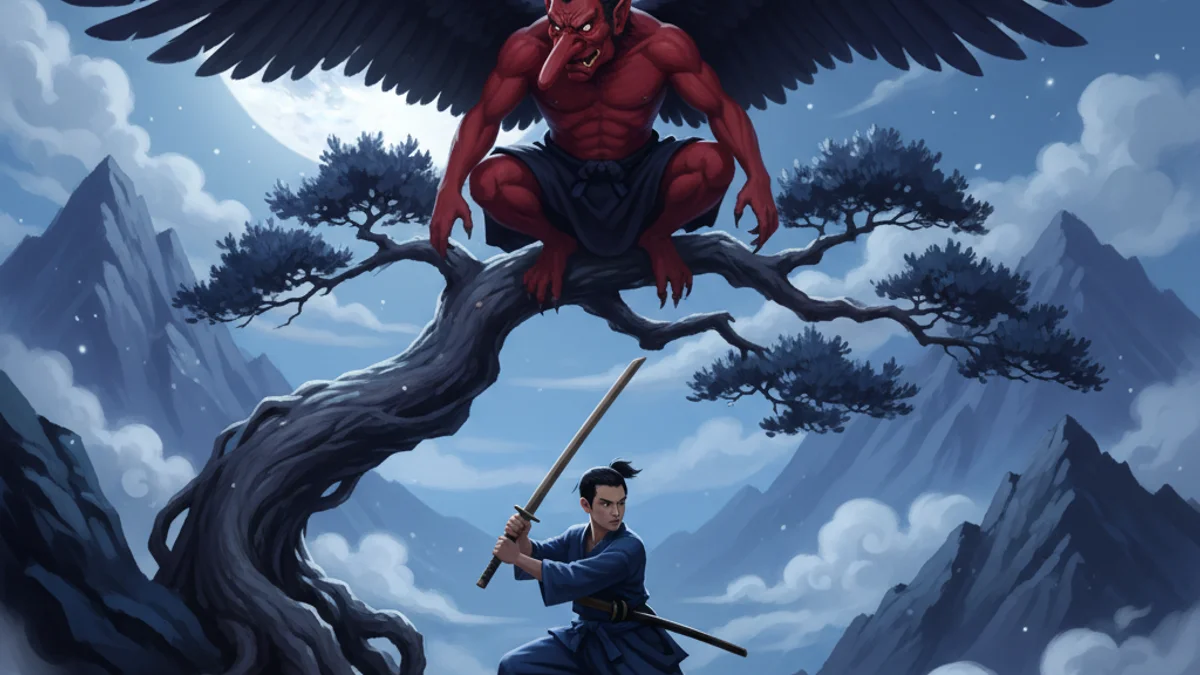
High atop Mount Kurama lived the Tengu, ancient mountain spirits known as masters of the sword and guardians of the wild. Among them was the King of the Tengu, Sojobo, a formidable being with long white hair and a crimson face. One night, a young boy named Ushiwaka-maru, seeking to avenge his fallen clan, ventured into the dark woods to find the legendary warriors. While most feared the Tengu as tricksters who kidnapped the arrogant, Ushiwaka-maru approached with deep respect and a pure heart. Impressed by the boy's resolve, Sojobo did not drive him away. Instead, the Tengu King and his avian spirits trained the boy in the secrets of martial arts, teaching him to move with the speed of the wind and the precision of a hawk. Years later, the boy emerged as Minamoto no Yoshitsune, the greatest samurai in Japanese history. The Tengu had transformed a vengeful child into a disciplined hero, proving that those who honor the spirits of the earth may gain wisdom beyond mortal reach.
The Moral
True mastery is attained through humility, respect for nature, and the discipline to use one's strength for a higher purpose.
“The mountain wind carries the secrets of the blade, but only the humble ear can hear them.”
Fun Fact
Originally, Tengu were depicted as kite-like birds of prey; over centuries, their beaks evolved into the iconic long noses we see in modern Japanese art.
Frequently Asked Questions
What is the moral of The Tengu?
The story teaches that skill and power are best acquired through humility and a deep respect for the spiritual world. It emphasizes that those who seek knowledge for a noble cause, rather than out of arrogance, will find supernatural guidance.
What exactly are Tengu in Japanese mythology?
Tengu are supernatural creatures or yōkai found in Japanese folklore, often depicted as mountain-dwelling spirits with both human and avian characteristics. They are traditionally viewed as protectors of the forests and masters of martial arts and strategy.
Why do some Tengu have long noses while others have beaks?
There are two main types: the Kotengu, who are more bird-like with beaks, and the Daitengu, who are more human-like with long noses. The long nose is often seen as a symbol of their immense power and, occasionally, their prideful nature.
Are Tengu considered good or evil spirits?
They are complex figures who are neither strictly good nor evil. While they were once feared as demons who misled monks, they later became seen as guardian spirits who punish the arrogant and reward those who show sincere dedication.
Who is the most famous person trained by a Tengu?
Minamoto no Yoshitsune is the most legendary figure associated with Tengu. Folklore states he learned his peerless swordsmanship from Sojobo, the King of the Tengu, while hiding in the mountains as a young boy.
How can you identify a Tengu in folklore?
They are usually identified by their red faces, long noses, large wings, and traditional attire such as the 'yamabushi' mountain monk robes. They often carry a 'hauchiwa' or feather fan that is said to be able to create powerful gales of wind.
Discussion (0)
Share your thoughts on this story
No comments yet. Be the first to share your thoughts!