Story Summary
Explore the Korean folktale The Tiger and the Dried Persimmon. A humorous legend about a fierce tiger who becomes terrified of a small, sweet piece of fruit.
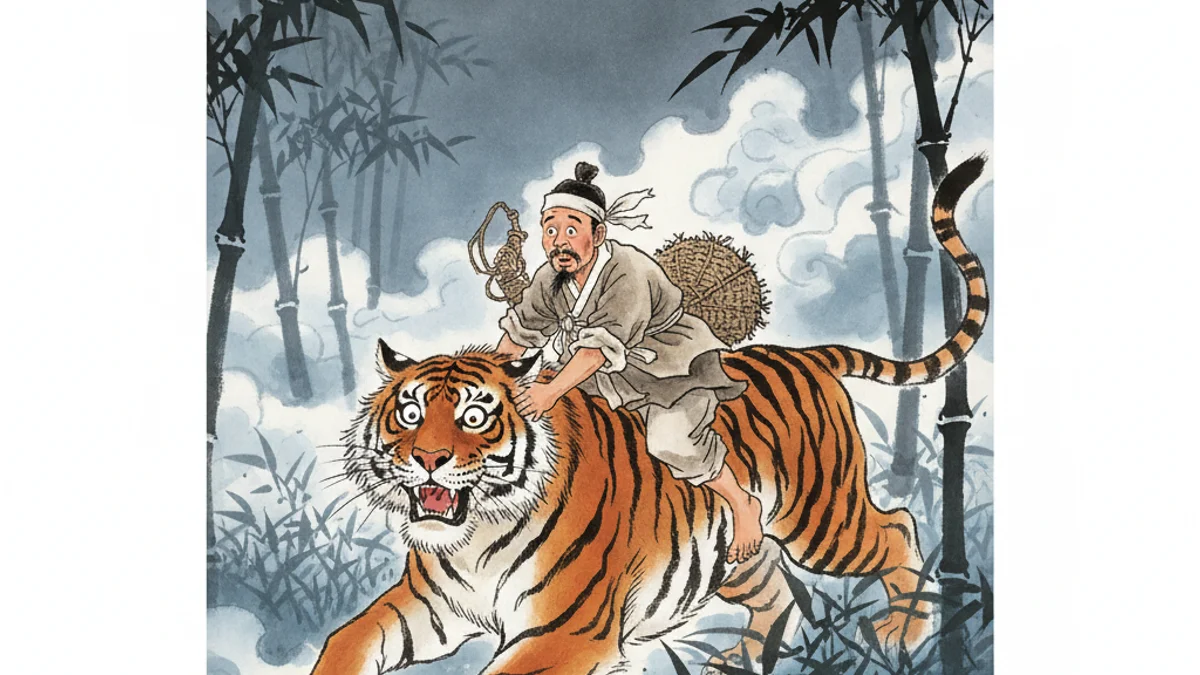
On a snowy winter night, a fierce tiger crept into a village, hungry for a meal. He crouched outside a house and heard a baby wailing inside. The mother tried to quiet the child, saying, 'Stop crying, or a wolf will get you!' The tiger scoffed, as the baby kept crying. Then she said, 'A tiger is outside!' The tiger was impressed that his name carried such weight, but the baby cried even louder. Finally, the mother whispered, 'Look, a dried persimmon!' Suddenly, the baby stopped crying. The tiger was struck with terror. He thought, 'This "Persimmon" must be a monster more terrifying than me to silence a child so instantly!' Just then, a cattle thief jumped onto the tiger’s back in the dark, thinking it was a cow. Convinced the Persimmon had finally caught him, the tiger bolted into the forest in a blind panic. The thief, realizing he was riding a tiger, eventually jumped off and hid, while the tiger kept running, grateful to have escaped the deadly Persimmon.
The Moral
Fear often stems from ignorance and imagination. Even the most powerful can be humbled by what they do not understand.
“Heavens! This dried persimmon must be a truly terrifying creature!”
Fun Fact
In many Korean tiger tales, the tiger is portrayed as a 'beom,' which can be either a fearsome predator or a foolish, comical creature that humans can outwit.
Frequently Asked Questions
What is the moral of The Tiger and the Dried Persimmon?
The moral is that fear is often a product of our own imagination and ignorance. It also serves as a satirical reminder that even those who think they are the most powerful can be easily humbled by misunderstanding.
Why was the tiger afraid of the dried persimmon?
The tiger assumed the 'persimmon' was a ferocious monster because it managed to stop the baby's crying immediately, something even the threat of a tiger could not do.
Is The Tiger and the Dried Persimmon a real Korean story?
Yes, it is a classic 'jeonrae donghwa' (traditional folktale) in Korea. It has been passed down for centuries as a humorous lesson for children and adults alike.
What does a dried persimmon represent in Korean culture?
Known as 'gotgam,' dried persimmons are a traditional Korean treat. In this story, the fruit represents how a simple, harmless object can be misinterpreted as something threatening.
Who is the 'villain' in the story?
The tiger begins as a traditional antagonist looking for prey, but the story quickly shifts his role into a comedic victim of his own cowardice and the cattle thief's greed.
Why is the tiger a common character in Korean myths?
Tigers are the national animal of Korea and appear frequently in folklore. They are often depicted as either sacred, mountain-ruling deities or, as in this tale, as bumbling characters who are easily outsmarted.
Discussion (0)
Share your thoughts on this story
No comments yet. Be the first to share your thoughts!