Story Summary
Explore the classic African folktale The Tortoise and the Elephant. Discover how a clever tortoise uses wit to outsmart a boastful giant in this trickster tale.
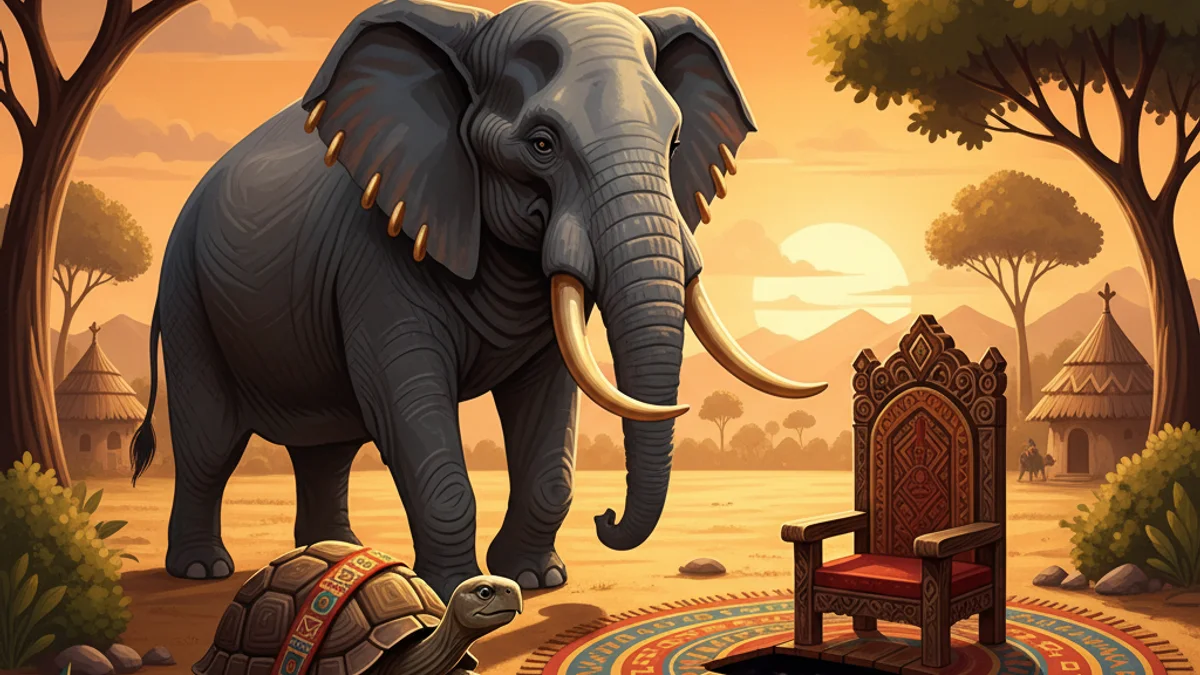
Long ago in the savanna, the Elephant boasted that his massive size made him the rightful ruler of all creatures. The Tortoise, tired of such arrogance, approached the giant with a humble bow. 'Great one,' the Tortoise whispered, 'the people of the nearby village have prepared a magnificent throne to crown you as their king.' Flattered by the prospect of power, the Elephant followed the tiny guide. They reached a village clearing where a golden throne sat atop a vibrant, patterned rug. 'Step up and claim your destiny,' the Tortoise urged. As the Elephant stepped forward to sit, the ground gave way beneath him. The villagers had dug a deep pit, and the Tortoise had concealed it with the rug and throne. The mighty giant fell into the trap, proving that a sharp mind is more powerful than any muscle.
The Moral
Intelligence and wit are far more powerful than raw physical strength and size.
“A crown does not only require a large head, but also a sharp mind to keep it.”
Fun Fact
In Yoruba culture, the tortoise is known as 'Ijapa' and is the central figure in many tales used to teach social ethics and cleverness.
Frequently Asked Questions
What is the moral of The Tortoise and the Elephant?
The moral is that intelligence and wit are superior to raw physical power. It serves as a reminder that being large and strong does not protect one from the consequences of vanity and gullibility.
Which culture does this folktale come from?
This story originates from the oral traditions of West Africa, particularly the Yoruba people of Nigeria. It features the tortoise, a common trickster figure in their folklore known as Ijapa.
Why did the Tortoise want to trick the Elephant?
The Tortoise wanted to prove that his intellect was a greater asset than the Elephant's size. His goal was to humble the boastful giant and demonstrate that wit can overcome any physical obstacle.
What was the specific trick used in the story?
The Tortoise convinced the Elephant that he was to be crowned king of a village. He led the Elephant to a throne placed over a deep pit covered by a decorative rug, causing the giant to fall into a trap.
What are the character traits of the Elephant?
In this tale, the Elephant represents physical dominance mixed with extreme vanity and a lack of foresight. His desire for status and power makes him an easy target for the Tortoise's manipulation.
Are there other similar trickster characters in African lore?
Yes, the Tortoise is one of several famous tricksters, alongside Anansi the Spider from Ghana and Zomo the Rabbit from West Africa. These characters use their wits to overcome much larger adversaries.
Discussion (0)
Share your thoughts on this story
No comments yet. Be the first to share your thoughts!