Story Summary
Read The Turtle and the Geese, a classic Panchatantra story about a talkative turtle who loses everything by speaking at the wrong time during a daring flight.
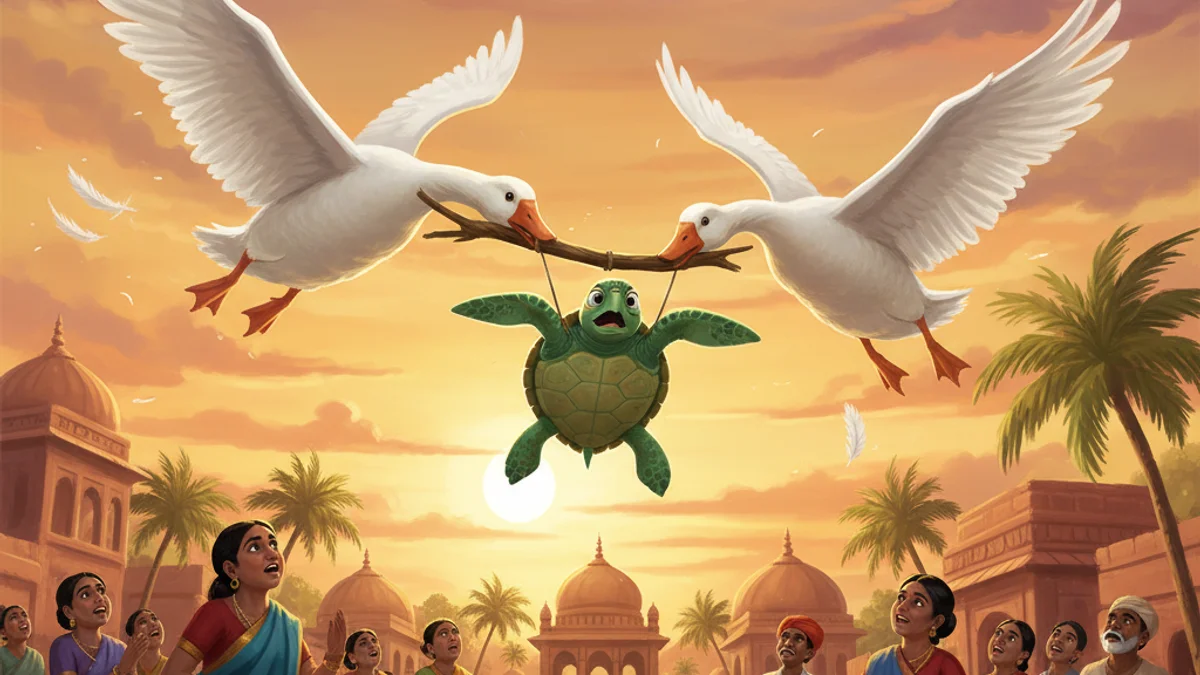
In a lush forest, a talkative turtle named Kambugriva lived in a beautiful lake with his two best friends, a pair of geese. When a severe drought struck the land, the lake began to dry up, threatening the turtle's life. To save their friend, the geese found a distant, water-filled lake and devised a clever plan: they would each hold the end of a sturdy stick in their beaks, while the turtle would cling to the middle with his mouth. Before takeoff, the geese gave a stern warning: 'You must remain silent throughout the journey, for if you open your mouth to speak, you will surely fall.' As they soared over a village, the townspeople looked up in amazement, mocking the strange sight. Unable to contain his indignation, the turtle opened his mouth to shout a retort. In that instant, he lost his grip and plummeted to the ground, meeting a tragic end because he could not control his tongue.
The Moral
Control your tongue and think before you speak; silence is often the best defense in critical situations.
“To speak at the wrong time is to invite your own destruction.”
Fun Fact
This story is over 2,000 years old and is featured in both the Hindu Panchatantra and the Buddhist Jataka tales to teach the value of restraint.
Frequently Asked Questions
What is the moral of The Turtle and the Geese?
The moral is that one should know when to stay silent and follow the advice of true friends. Talking at the wrong moment can lead to ruin and disaster.
Why did the turtle fall in the story?
The turtle fell because he opened his mouth to reply to the mocking comments of the people on the ground. By speaking, he lost his grip on the stick the geese were carrying.
Is The Turtle and the Geese a Panchatantra story?
Yes, it is one of the most famous fables from the Panchatantra, an ancient Indian collection of animal fables originally written in Sanskrit.
What are the names of the geese and the turtle?
In the original Sanskrit version, the turtle is named Kambugriva, while the two faithful geese are named Sankata and Vikata.
What lesson does this story teach children?
It teaches children the importance of self-control and listening to wise warnings. It highlights how pride and the inability to ignore distractions can lead to negative consequences.
Are there different versions of this fable?
Yes, variations of this story appear in the Buddhist Jataka tales and even in Aesop's Fables, usually involving a tortoise and various birds.
Discussion (0)
Share your thoughts on this story
No comments yet. Be the first to share your thoughts!