Story Summary
In the fable of The Two Pots, a clay pot and a brass pot float down a river. Learn why the fragile pot refuses the protection of its stronger companion.
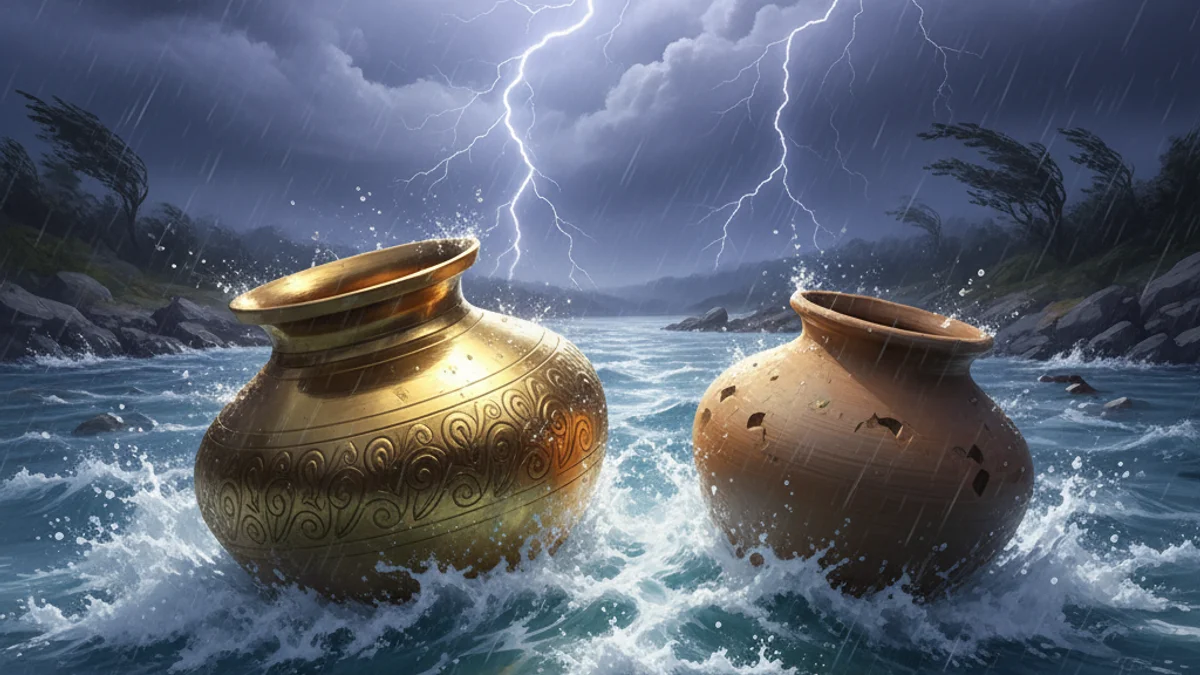
A river rose in flood and swept away two pots that had been standing on the bank. One was made of brass, and the other of clay. As they floated downstream together, the brass pot called out to his companion, 'Stay close to me, friend, and I shall protect you from harm.' But the clay pot replied, 'I thank you for your kind offer, but it is your very closeness that I fear. Whether the stream hits us together or we collide by chance, it is I who will shatter while you remain whole. For my own safety, I must keep my distance.'
The Moral
Equal companionship is safest; the weak should avoid the company of the strong to prevent accidental destruction.
“Whether the stream strikes us or we strike each other, I am the one who will break.”
Fun Fact
This fable was notably included in the 15th-century collection 'Hecamythium' by Laurentius Abstemius, which helped popularize it alongside other classic Aesopic tales.
Frequently Asked Questions
What is the moral of The Two Pots?
The moral is that the weak should not associate too closely with the strong, as even a well-intentioned touch can cause the fragile party to break. Safety often lies in seeking companions of equal standing and nature.
Why did the clay pot refuse the brass pot's help?
The clay pot recognized that the brass pot's hard exterior was a physical threat. It understood that any collision, whether accidental or intended for protection, would result in the clay pot shattering.
Who is the author of The Two Pots?
The story is traditionally attributed to Aesop, the ancient Greek storyteller. It has been featured in various collections of Aesop's Fables for centuries as a lesson in social and political dynamics.
What do the two pots symbolize in the fable?
The pots symbolize different social classes or levels of power. The brass pot represents the powerful and influential, while the clay pot represents the vulnerable or those with fewer resources.
Is the brass pot a villain in this story?
Not necessarily; in many versions, the brass pot is genuinely trying to be helpful. The fable emphasizes that harm can occur due to a disparity in nature rather than just through malice.
How can the fable of The Two Pots be applied today?
It serves as a cautionary tale for business or personal partnerships where there is a massive power imbalance. It suggests that the smaller party often carries the most risk when things get turbulent.
Discussion (0)
Share your thoughts on this story
No comments yet. Be the first to share your thoughts!