Story Summary
Discover the Maasai legend The Warrior and the Moon, a powerful fable where a proud hunter learns that human strength is nothing without the light of the heavens.
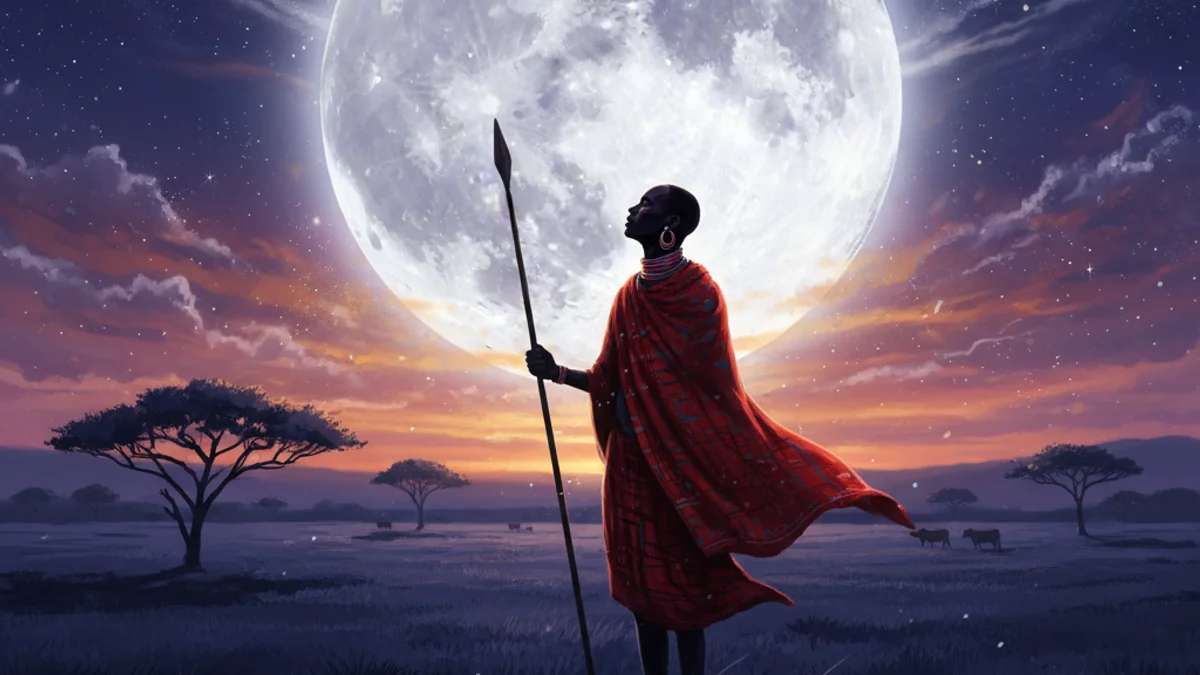
Ol-lowuaru was a warrior of unmatched pride, boasting that his spear could strike any foe and his eyes could pierce any shadow. One night, as the full moon hung heavy over the Rift Valley, he shook his weapon at the sky, mocking the Moon for her soft, pale light. He claimed that he did not need her guidance to hunt or protect his cattle. Offended by his arrogance, the Moon withdrew her silver veil, plunging the plains into a darkness so absolute that the warrior could not see his own hand. Lost and terrified, Ol-lowuaru wandered in circles, tripping over thorns and falling into ravines. He realized then that his strength was nothing without the light provided by the heavens. When the Moon finally returned as a thin, merciful crescent, Ol-lowuaru bowed low, finally understanding that even the greatest warrior is but a speck beneath the eternal watchful eye of the sky.
The Moral
True strength is hollow without the humility to recognize and respect the forces of nature that guide us.
“Strength without light is merely a path to the shadows.”
Fun Fact
In Maasai mythology, the Sun and the Moon are often viewed as a divine couple, and the Moon's phases are used to determine the timing of important cultural ceremonies.
Frequently Asked Questions
What is the moral of The Warrior and the Moon?
The moral is that pride leads to a fall and that human strength is dependent on the natural world. It teaches humility and respect for the celestial forces that govern our lives.
Who is the main character in this Maasai tale?
The main character is Ol-lowuaru, a skilled but arrogant warrior who believes his physical prowess makes him superior to the elements.
Why did the Moon take away her light?
The Moon withdrew her light to teach the warrior a lesson after he mocked her and claimed he did not need her guidance to survive the night.
What does the Moon symbolize in Maasai folklore?
The Moon often symbolizes wisdom, the passage of time, and a divine witness to human actions. In this story, she represents the humbling power of nature.
Is The Warrior and the Moon a traditional oral story?
Yes, it is part of the rich oral tradition of the Maasai people, used to pass down values of humility and cosmic respect to younger generations.
How does the story end for the warrior?
The warrior survives the darkness but is deeply humbled. He learns to honor the night sky and recognizes that his spear cannot protect him from the loss of light.
Discussion (0)
Share your thoughts on this story
No comments yet. Be the first to share your thoughts!