Story Summary
Experience The Wooden Sword Victory, the legendary duel where Miyamoto Musashi defeats Sasaki Kojiro using a carved oar, proving strategy beats the finest steel.
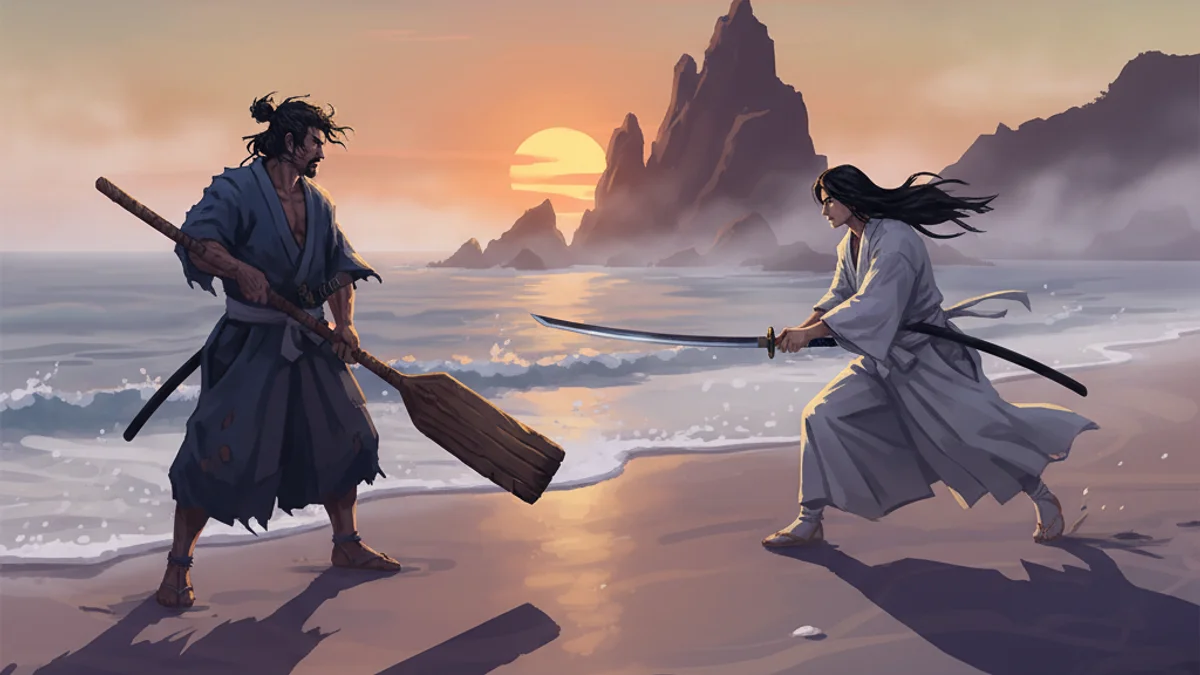
In 1612, the legendary swordsman Miyamoto Musashi traveled to Ganryu Island to face his greatest rival, Sasaki Kojiro. Known for his deadly 'Swallow Cut' and a nodachi of exceptional length, Kojiro was considered a master of the blade. Musashi arrived intentionally late, testing Kojiro's patience and composure as the sun rose higher. During the boat ride to the island, Musashi took a spare oar and used his knife to carve it into a crude, heavy wooden sword. When he finally stepped onto the sand, Kojiro, enraged by the delay, drew his long blade and threw his scabbard into the sea. Musashi calmly remarked that Kojiro had already lost, for a winner would have need of his scabbard. As the two masters clashed, Musashi used the superior reach of his wooden oar to strike a fatal blow to Kojiro’s head at the exact moment Kojiro’s blade sliced Musashi’s headband. With a single strike from a piece of wood, Musashi proved that true victory is won in the mind before the sword is even drawn.
The Moral
True mastery is found in the mind and strategy, not in the quality or sharpness of the weapon.
“If you have no need for your scabbard, you have already lost.”
Fun Fact
The island where the duel took place was originally called Funashima but was later renamed Ganryu Island to honor Sasaki Kojiro’s school of swordsmanship.
Frequently Asked Questions
What is the moral of The Wooden Sword Victory?
The story teaches that strategic thinking and psychological preparation are more important than physical equipment. Musashi's victory shows that a master can turn any tool into a winning weapon through superior timing and mindset.
Who was Sasaki Kojiro in Japanese history?
Sasaki Kojiro was a prominent Japanese swordsman known as the 'Demon of the Western Provinces.' He was famous for his long sword, the Monohoshizao, and his 'Swallow Cut' technique which was said to be faster than a bird in flight.
Why did Musashi arrive late to the duel?
Musashi arrived late as a tactic of psychological warfare. By making Kojiro wait for hours, he successfully agitated and angered his opponent, causing Kojiro to lose the calm focus required for a high-stakes duel.
Why did Musashi use a wooden sword instead of a metal one?
Musashi carved the oar to have a longer reach than Kojiro's exceptionally long blade. By using a wooden sword (bokken) of his own making, he negated Kojiro's advantage of distance and surprised him with an unconventional weapon.
What is the significance of the discarded scabbard?
When Kojiro threw his scabbard into the water, Musashi interpreted it as a sign of Kojiro's lack of confidence in his own survival. It was a psychological opening that Musashi exploited to further unsettle his rival.
Is the duel at Ganryu Island a true story?
Yes, the duel is a documented historical event from the Edo period of Japan. While some details have been romanticized in literature and film, the battle remains the most famous encounter in samurai history.
Discussion (0)
Share your thoughts on this story
No comments yet. Be the first to share your thoughts!