Story Summary
Discover how the monk Xuanzang begins his journey to the West. Guided by the Bodhisattva Guanyin, he leaves the Tang capital to seek sacred Buddhist scriptures.
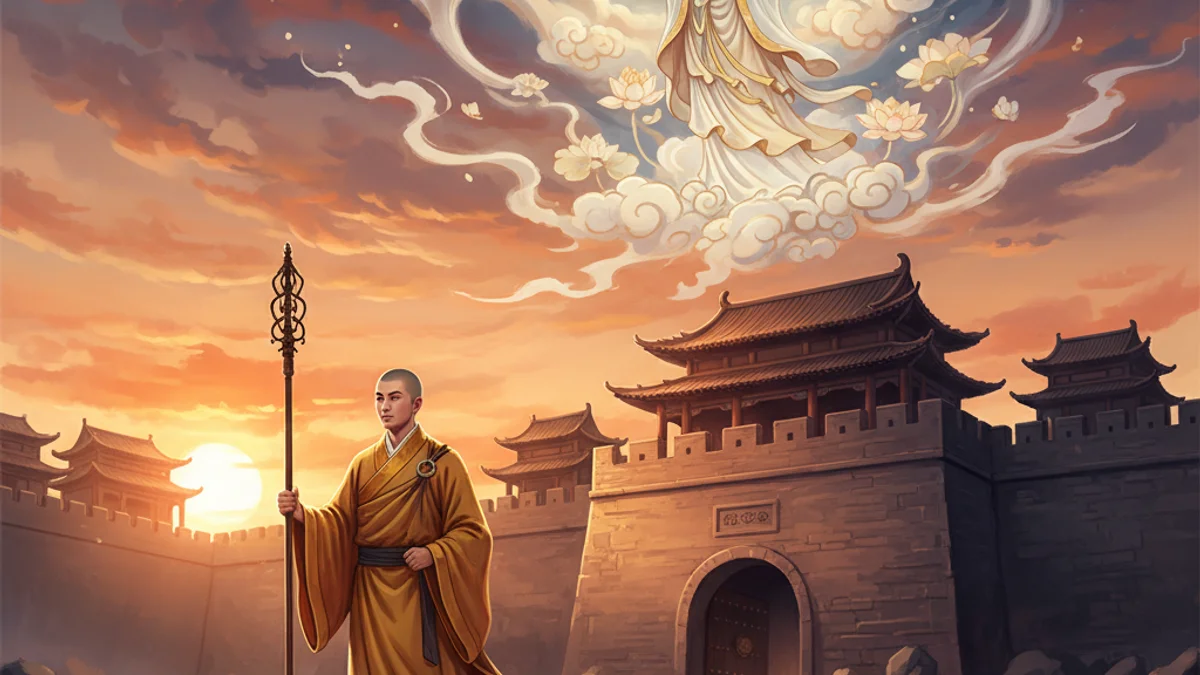
In the heart of the Tang Dynasty, the Empire was plagued by spiritual unrest. Seeking a remedy, Emperor Taizong held a Great Mass for the dead, but the prayers offered lacked the power of true salvation. Suddenly, the Bodhisattva Guanyin appeared, disguised as a humble monk, revealing that the true path to enlightenment lay in the 'Three Baskets' of Mahayana scriptures kept in the Western Heaven. A young, virtuous monk named Xuanzang, known for his deep wisdom and purity, stepped forward. Moved by the plight of the people, he vowed to undertake the perilous trek to India to retrieve the scriptures. The Emperor, impressed by his courage, declared Xuanzang his sworn brother and gifted him a golden-embroidered cassock and a nine-ringed staff. As the sun rose over the gates of Chang'an, Xuanzang mounted his horse and set out alone, prepared to face countless demons and treacherous terrain for the sake of his faith and his country.
The Moral
True spiritual growth and the service of others require the courage to leave one's comfort and face the unknown with unwavering faith.
“I shall not return to the East until I have reached the Western Heaven and obtained the true scriptures.”
Fun Fact
The historical Xuanzang traveled over 10,000 miles on foot and brought back 657 Buddhist texts to China, becoming one of the greatest translators in history.
Frequently Asked Questions
What is the moral of Xuanzang Begins His Journey?
The story teaches that great spiritual tasks require sacrifice and a heart that does not waver in the face of immense difficulty. It emphasizes that the path to wisdom often begins with a single, courageous step into the unknown.
Why did Xuanzang go to the West?
He sought to retrieve the Tripiṭaka, or the Three Baskets of Mahayana scriptures, from India. These texts were believed to be the only way to save suffering souls and bring peace to the Tang Empire.
Who gave Xuanzang his mission?
The mission was suggested by the Bodhisattva Guanyin, who revealed the existence of the scriptures. He was officially commissioned and supported by Emperor Taizong of the Tang Dynasty.
Was Xuanzang a real person?
Yes, he was a real 7th-century monk who spent 17 years traveling to India. His real-life journals inspired the fantastical 'Journey to the West' novel written centuries later.
What items did Xuanzang take on his journey?
He was gifted a white horse, a nine-ringed staff, and a golden cassock. In the myth, these items possess spiritual significance and help protect him from evil forces.
What does the title Journey to the West represent?
It represents both the physical travel from China to India and a spiritual allegory for the journey toward enlightenment. Each obstacle the monk faces represents a human vice or struggle.
Discussion (0)
Share your thoughts on this story
No comments yet. Be the first to share your thoughts!