Story Summary
In the classic Sufi tale Nasrudin Feeds His Coat, the wise fool uses a banquet to prove that people often value expensive clothing over a person's character.
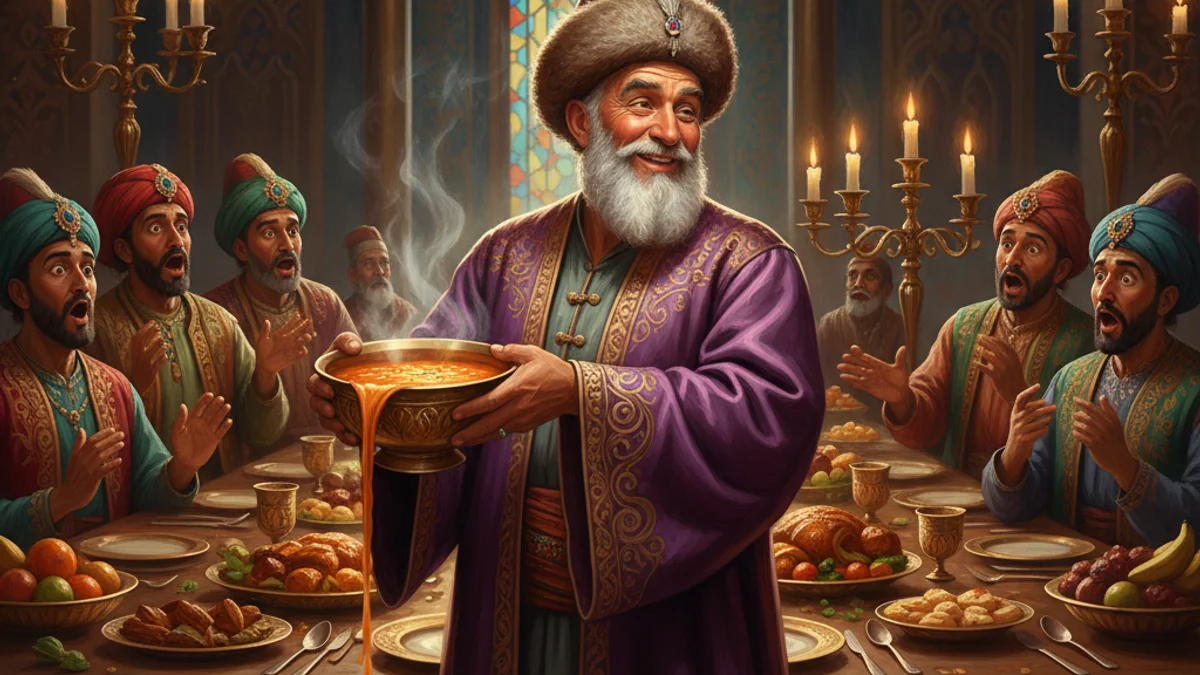
Mulla Nasrudin was invited to a grand banquet. Arriving straight from his fields in tattered, dusty clothes, he was ignored by the host and guests alike. No one offered him a seat or even a glass of water. Nasrudin quietly slipped away, went home, and dressed in his finest silk coat with a fur collar and a magnificent turban. When he returned, the host greeted him with deep bows and escorted him to the place of honor. As the feast began, Nasrudin took a spoonful of soup and poured it into his sleeve. He picked up a handful of pilaf and rubbed it into his coat, whispering, 'Eat, coat, eat!' The host was horrified and asked, 'Mulla, what are you doing?' Nasrudin replied calmly, 'When I came in rags, you offered me nothing. When I came in this coat, you gave me a feast. It is clear that the food was meant for my clothes, not for me.'
The Moral
True worth lies within a person's character, yet society often mistakenly judges individuals based solely on their outward appearance and wealth.
“Eat, coat, eat! For it was you who was invited to the feast, not I.”
Fun Fact
Mulla Nasrudin is celebrated as a national hero in Turkey, where an annual festival is held in Akşehir to honor his memory and wit.
Frequently Asked Questions
What is the moral of Nasrudin Feeds His Coat?
The moral is that social status and appearances are superficial. It critiques the human tendency to offer respect based on wealth and clothing rather than the actual person or their character.
Why did Nasrudin pour soup on his clothes?
He did this to highlight the hypocrisy of his host. Since he was only welcomed after changing into expensive attire, he concluded the food was intended for his coat, not himself.
Who is Mulla Nasrudin?
Mulla Nasrudin is a legendary Sufi figure and 'wise fool' found in folklore across the Middle East and Central Asia. His stories use humor to convey deep philosophical and spiritual truths.
What does the coat symbolize in this story?
The coat symbolizes external vanity and the masks of social status. It represents the shallow criteria by which society often measures a person's value or importance.
Is this story part of a specific religious tradition?
It is a Sufi parable, part of the mystical branch of Islam. These stories are designed to break down the ego and challenge the listener's conventional ways of thinking.
How does the host react to Nasrudin's actions?
The host is initially confused and embarrassed by Nasrudin's behavior at the table. This sets the stage for Nasrudin to deliver his sharp, witty lesson on hospitality and prejudice.
Discussion (0)
Share your thoughts on this story
No comments yet. Be the first to share your thoughts!