Story Summary
Discover the myth of Shiva Burns Kamadeva, where the God of Love sacrifices his form to awaken Shiva from meditation and save the world from Tarakasura.
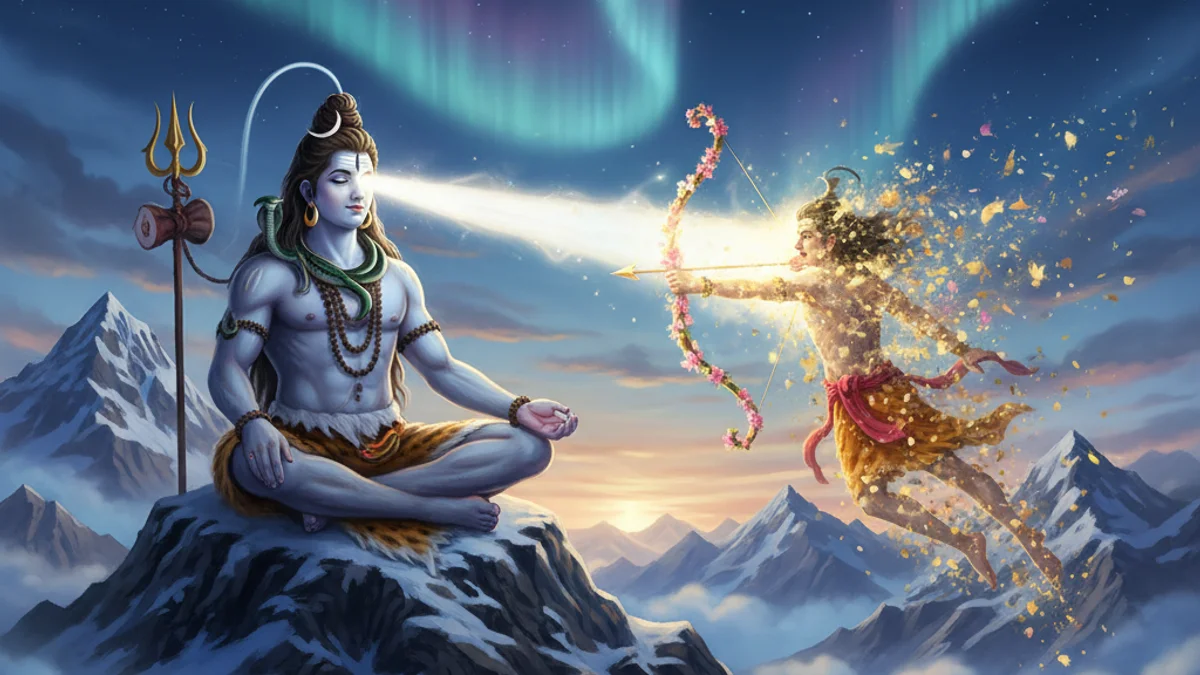
After the loss of his consort Sati, Lord Shiva withdrew into a profound meditation on Mount Kailash, detached from the universe. During this time, the demon Tarakasura conquered the heavens, protected by a boon that only a son of Shiva could slay him. Desperate, the gods sought to unite Shiva with Parvati, the reincarnation of Sati. They sent Kamadeva, the God of Love, to break Shiva's penance. As Parvati approached the Lord, Kamadeva aimed his bow of sugarcane and fired an arrow of flowers. The arrow struck Shiva’s heart, momentarily stirring his senses. Sensing the intrusion, Shiva’s eyes snapped open in fury. He located Kamadeva hiding behind a tree and opened his third eye. A terrifying beam of cosmic fire erupted, instantly incinerating the God of Love into a heap of ash. Though Kamadeva was destroyed, the seed of desire was planted, eventually leading to the birth of the warrior-god Kartikeya.
The Moral
Divine will and cosmic order often require the sacrifice of personal ego and the mastery of worldly desires.
“Even the God of Love cannot withstand the fire of a mind perfectly stilled in truth.”
Fun Fact
Because he was reduced to ash and lost his physical form, Kamadeva is often referred to in Sanskrit literature as 'Ananga,' which literally translates to 'The Formless One.'
Frequently Asked Questions
Why did Shiva burn Kamadeva?
Shiva burned Kamadeva because the God of Love disturbed his deep meditation with an arrow of desire. Shiva, the supreme ascetic, saw this as an unwelcome intrusion into his spiritual penance.
Who asked Kamadeva to disturb Shiva?
The gods, led by Indra, requested Kamadeva's help because only a son born to Shiva could defeat the demon Tarakasura. They needed to provoke Shiva's interest in the goddess Parvati.
What happened to Kamadeva after he was burned?
He became known as 'Ananga,' the bodiless one. Later, in response to his wife Rati's prayers, Shiva allowed him to be reborn as Pradyumna, the son of Lord Krishna.
What are the weapons of Kamadeva?
Kamadeva carries a bow made of sugarcane with a string of honeybees. His arrows are tipped with five types of fragrant flowers that incite different stages of love and passion.
What is the symbolic meaning of this story?
The story symbolizes the triumph of spiritual discipline over physical lust. It illustrates that for creation to occur, the raw fire of desire must sometimes be refined by the fire of wisdom.
Does this story relate to any Indian festivals?
Yes, in many parts of India, particularly in the south, the story is remembered during the Holi season. Bonfires are lit to symbolize the burning of Kamadeva and the destruction of worldly attachments.
Discussion (0)
Share your thoughts on this story
No comments yet. Be the first to share your thoughts!