Story Summary
Discover the powerful story of The Buddha and Angulimala, a tale of a ruthless bandit who finds spiritual redemption and peace through the Buddha's wisdom.
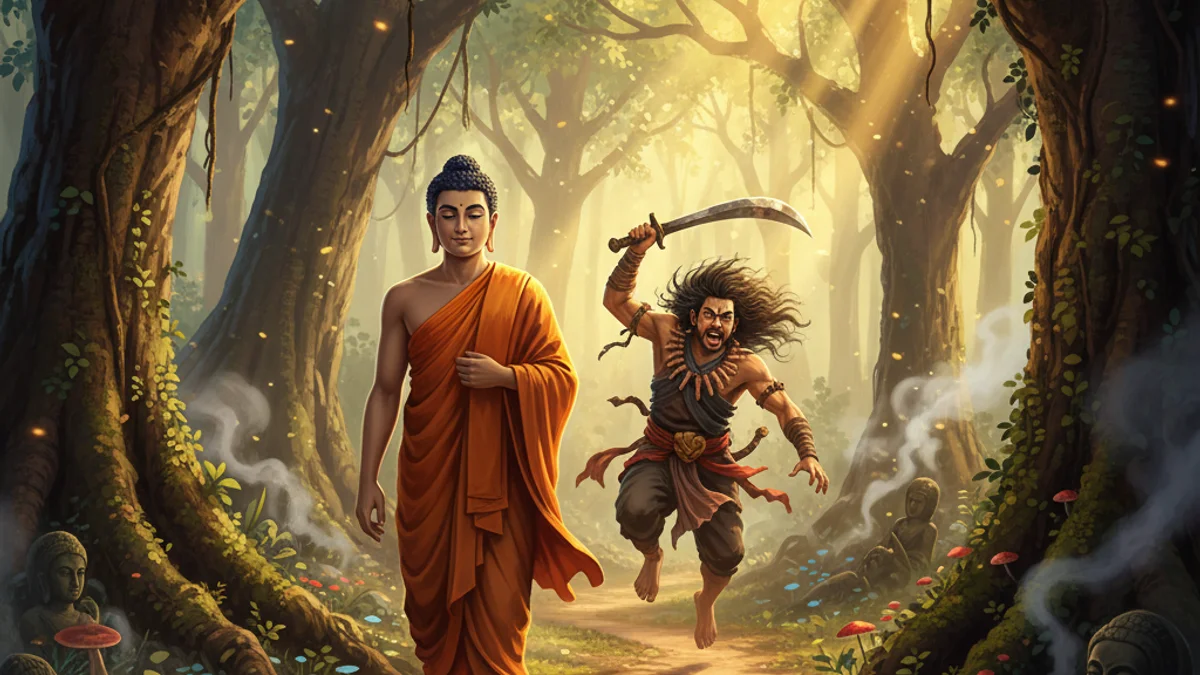
Angulimala was a dreaded bandit who lived in the Jalini forest. Driven by a misguided vow to his teacher, he sought to collect a thousand human fingers to form a necklace. He had already killed 999 people and needed just one more. When he saw the Buddha walking calmly through the woods, Angulimala drew his sword and gave chase. Despite running with all his might, he could not catch the Buddha, who appeared to be walking at a slow, peaceful pace. Frustrated, the bandit shouted, 'Stop, monk!' The Buddha replied, 'I have stopped, Angulimala; it is you who have not stopped.' Confused, Angulimala asked for an explanation. The Buddha explained that he had stopped committing violence and causing harm to living beings, while Angulimala was still driven by cruelty. Struck by this profound truth, Angulimala threw away his weapons, asked for forgiveness, and joined the monastic order. He eventually attained enlightenment, proving that even the most hardened heart can find peace.
The Moral
No person is beyond redemption, and true peace is found only when one stops causing harm to others.
“I have stopped, Angulimala. You should stop too.”
Fun Fact
The Angulimala Paritta, a verse associated with this story, is still traditionally chanted by Buddhist monks to bless expectant mothers for a safe and easy delivery.
Frequently Asked Questions
What is the moral of The Buddha and Angulimala?
The moral is that no one is beyond redemption. It teaches that even those who have committed great wrongs can change their lives through mindfulness and compassion.
What does the name Angulimala mean?
The name Angulimala translates to 'Finger Garland.' It refers to the necklace made of human fingers that he wore to keep count of his victims.
Why couldn't Angulimala catch the Buddha?
While the story describes it as a miraculous feat, it serves as a metaphor for the Buddha's spiritual stillness versus Angulimala's chaotic, violent mind.
Was Angulimala a real person?
In Buddhist tradition, Angulimala is considered a historical figure who lived during the time of the Buddha and eventually became an Arahant, or enlightened being.
What was Angulimala's name before he became a bandit?
His original name was Ahimsaka, which means 'the innocent one' or 'non-violent one,' highlighting his tragic fall from grace before his redemption.
How did the community react to Angulimala becoming a monk?
Initially, the people were terrified and angry, but the Buddha's protection and Angulimala's genuine transformation eventually led to his acceptance as a peaceful monk.
Discussion (0)
Share your thoughts on this story
No comments yet. Be the first to share your thoughts!