Story Summary
Discover the pivotal story of The Buddha and Sujata, where a simple offering of milk rice helped Siddhartha Gautama find the Middle Way to enlightenment.
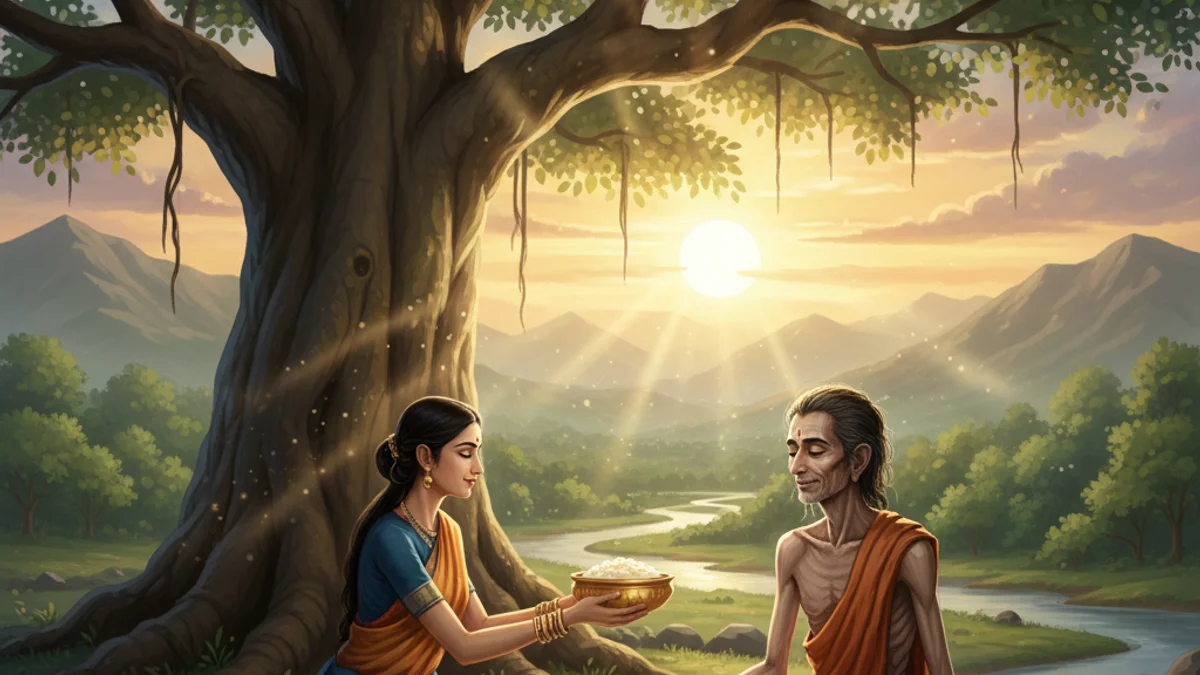
For six long years, Siddhartha Gautama practiced extreme asceticism, pushing his body to the brink of starvation. He grew so frail that his ribs showed like the rafters of a broken roof, yet he was no closer to enlightenment. Realizing that a weak body could not sustain a strong mind, he decided to abandon the path of self-mortification. At that time, a young woman named Sujata from the village of Senani arrived at the Banyan tree where Siddhartha sat. She had made a vow to the tree deity and brought a golden bowl filled with creamy milk rice, cooked with great devotion. Mistaking the serene Siddhartha for the tree spirit, she offered him the meal. Siddhartha accepted the nourishment, bathed in the Niranjana River, and ate. This simple act of kindness restored his strength, allowing him to sit beneath the Bodhi tree with a clear mind and eventually attain full enlightenment. Sujata’s humble gift became the bridge between his years of suffering and his ultimate awakening.
The Moral
The path to wisdom lies in the Middle Way, avoiding the extremes of indulgence and self-deprivation.
“The Middle Way is the path that leads to peace, discernment, enlightenment, and Nirvana.”
Fun Fact
The Sujata Stupa in Bakraur was built to commemorate the site where Sujata lived and offered the milk rice to Siddhartha Gautama.
Frequently Asked Questions
What is the moral of The Buddha and Sujata?
The moral is that spiritual growth requires a balance between the mind and body, known as the Middle Way. It teaches that extreme self-denial is just as ineffective as over-indulgence.
Who was Sujata in Buddhist history?
Sujata was the daughter of a village chief who offered the Buddha-to-be his last meal before his enlightenment. She is celebrated as one of the most significant female figures in the Buddha's journey.
What did Sujata offer to Siddhartha?
Sujata offered a special dish of rice milk, known as kheer or payas, served in a golden vessel. She had originally prepared it as an offering to a tree deity for granting her a wish.
Why was the milk rice offering significant?
It was significant because it provided Siddhartha with the physical strength needed for his final meditation. It also marked his realization that extreme asceticism was not the path to truth.
Where did the story of Sujata and Buddha take place?
The encounter took place near the Niranjana River in Uruvela, which is located in modern-day Bodh Gaya, India. This area is now a major site for Buddhist pilgrimage.
What happened after Siddhartha accepted Sujata's gift?
After eating the rice, Siddhartha regained his vitality and vowed to sit in meditation until he reached enlightenment. He attained Buddhahood later that same night under the Bodhi tree.
Discussion (0)
Share your thoughts on this story
No comments yet. Be the first to share your thoughts!