Story Summary
Experience the wisdom of Rumi's The Elephant in the Dark. A famous Sufi parable about how individual perspectives fail to grasp the whole truth without light.
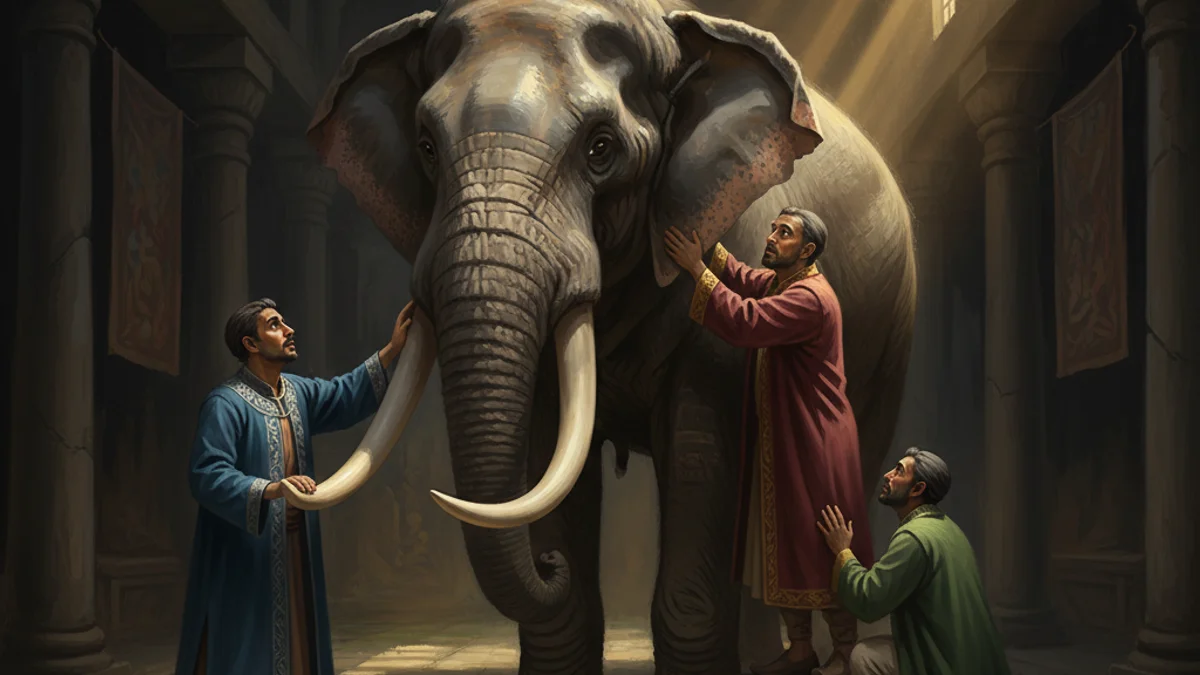
An elephant was brought to a village by some travelers from India and placed in a dark room. Curious locals flocked to see the mysterious creature, but since the room was pitch black, they had to rely on their touch. One man felt the elephant’s trunk and declared, 'This creature is like a thick water pipe!' Another touched its ear and argued, 'No, it is like a large, broad fan.' A third man, having felt a leg, insisted, 'You are both wrong; it is clearly a massive pillar.' A fourth, stroking its back, claimed it was a majestic throne. Each man was convinced of his own truth based on the fragment he had touched. Because they lacked light, they could only perceive parts, and their limited perspectives led to endless disagreement rather than understanding the magnificent whole.
The Moral
Human perception is often limited and subjective; to understand the absolute truth, one must combine individual perspectives and seek the light of wisdom.
“If each of us held a candle, the differences would vanish.”
Fun Fact
This parable is so universal that it appears in various forms across the globe, including a famous 19th-century poem by John Godfrey Saxe.
Frequently Asked Questions
What is the moral of The Elephant in the Dark?
The moral is that individual perception is limited and can lead to false conclusions. We must look beyond our subjective experiences and seek a collective, enlightened view to understand the complete truth.
Who is the original author of this parable?
While most famously told by the Sufi poet Rumi in his Masnavi, the story has much older roots in Buddhist, Jain, and Hindu traditions. Rumi adapted it to illustrate spiritual ignorance and the need for divine light.
What does the elephant symbolize in the story?
The elephant typically symbolizes the Divine, the Absolute Truth, or a complex reality that is too vast for any single human sense or mind to fully comprehend at once.
Why is the setting of the story a dark room?
The darkness represents human ignorance and the limitations of the physical senses. Without the 'light' of spiritual knowledge or holistic reason, we are unable to see things as they truly are.
What does Rumi say would solve the men's disagreement?
Rumi suggests that if each person had held a candle, the light would have revealed the whole elephant. This implies that shared wisdom and spiritual insight can resolve conflicting viewpoints.
How is this story relevant today?
It serves as a reminder for empathy and open-mindedness in modern debates. It teaches us that others may have a piece of the truth even if their perspective differs significantly from our own.
Discussion (0)
Share your thoughts on this story
No comments yet. Be the first to share your thoughts!