Story Summary
Read the classic Aesop's Fable, The Fox and the Grapes. Discover why a hungry fox decides unreachable fruit is sour in this timeless tale about cognitive dissonance.
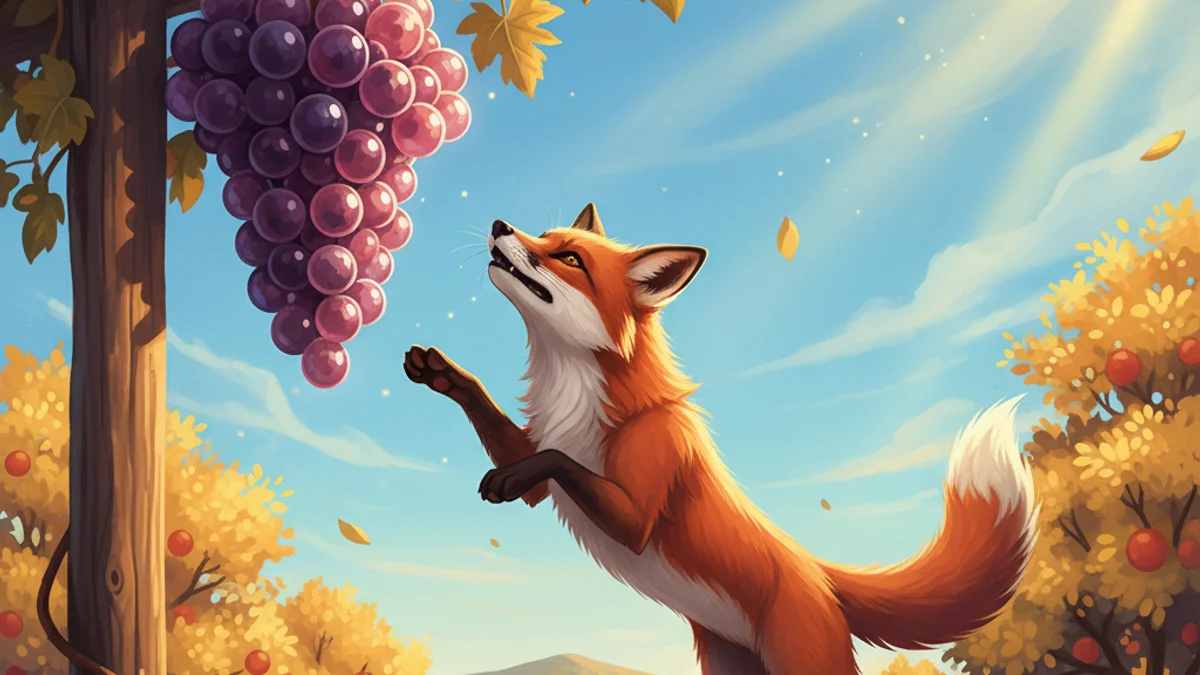
On a scorching summer afternoon, a thirsty fox wandered through an orchard until he spotted a bunch of succulent, purple grapes hanging from a high vine. 'Just the thing to quench my thirst,' he remarked. He took a few steps back, leaped, and narrowly missed the branch. He tried again and again, jumping with all his might, but the grapes remained just out of reach. Finally, exhausted and frustrated, he turned away with his nose in the air, muttering, 'I am sure they are sour anyway.'
The Moral
It is easy to despise what you cannot get.
“I am sure they are sour anyway.”
Fun Fact
The phrase 'sour grapes' has become so embedded in the English language that it is used globally to describe rationalizing away a failure.
Frequently Asked Questions
What is the moral of The Fox and the Grapes?
The moral is that people often disparage things they want but cannot have to save face. It illustrates the concept of 'sour grapes,' where one pretends something is worthless because it is unattainable.
Where does the phrase 'sour grapes' come from?
The idiom originates directly from this Aesop’s fable. It describes the attitude of someone who acts as if something is undesirable only because they failed to achieve or acquire it.
Is the fox in the story real or metaphorical?
While the story features a literal fox, it serves as a metaphor for human behavior and psychological defense mechanisms. The fox represents anyone who uses rationalization to cope with failure.
Who wrote The Fox and the Grapes?
The story is attributed to Aesop, a storyteller believed to have lived in ancient Greece. His fables were passed down orally for centuries before being recorded in various literary collections.
What does the fox do when he can't reach the grapes?
After several failed attempts to jump and reach the high-hanging fruit, the fox gives up. To soothe his bruised ego, he convinces himself that the grapes were probably sour and not worth having anyway.
Why is this fable still popular today?
This fable remains popular because it perfectly captures a universal human tendency called cognitive dissonance. It provides a simple, relatable way to teach children and adults about the dangers of self-deception.
Discussion (0)
Share your thoughts on this story
No comments yet. Be the first to share your thoughts!