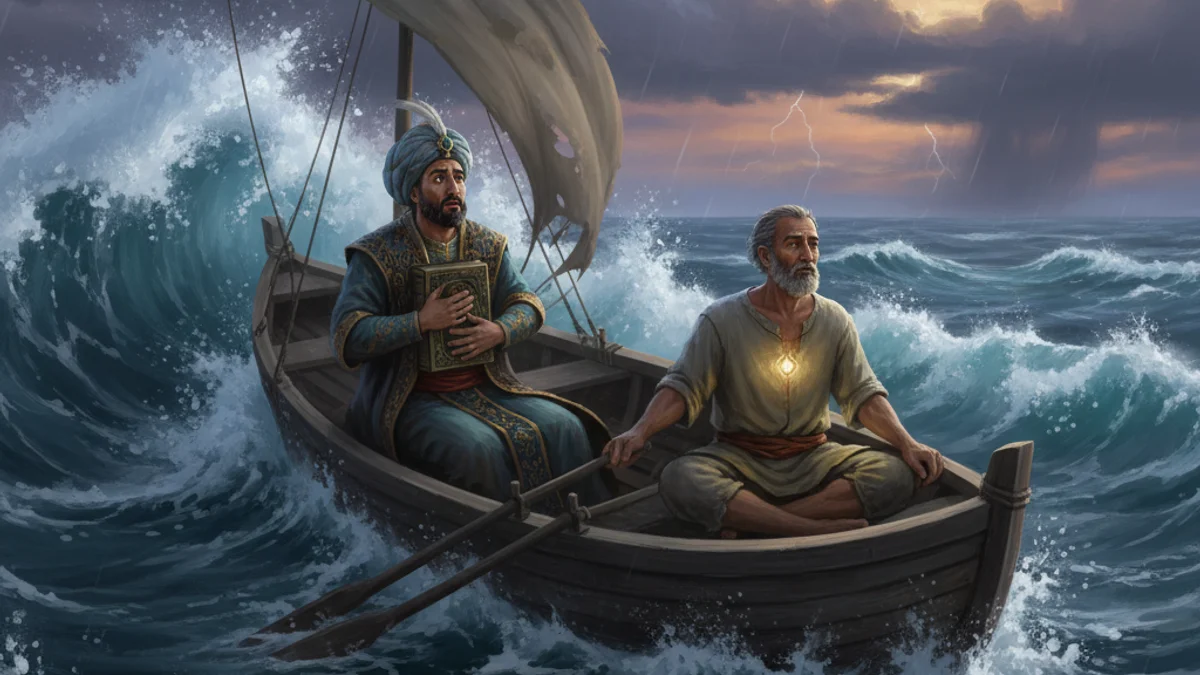
Story Summary
Explore Rumi's classic tale, The Grammarian and the Boatman. Learn why intellectual pride fails when the storms of life require practical spiritual wisdom.
A proud grammarian once stepped onto a boat to cross a wide river. Turning to the humble boatman, he asked with an air of superiority, 'Have you ever studied the intricacies of grammar?' The boatman replied simply, 'No, I have not.' The grammarian sighed and shook his head, saying, 'Alas! Then half your life has been wasted!' The boatman remained silent, feeling the sting of the scholar's words. Suddenly, a violent storm erupted, and the boat began to fill with water and sink into the churning waves. The boatman shouted to the terrified scholar, 'Tell me, master, do you know how to swim?' 'No,' the grammarian cried out in fear. 'Then,' the boatman replied calmly as he dived into the water, 'your whole life has been wasted, for the boat is sinking.'
The Moral
Intellectual knowledge and pride are useless if one lacks the practical wisdom or spiritual preparation to navigate the crises of life.
“Do you know how to swim? No? Then your whole life has been wasted.”
Fun Fact
This story is part of Rumi's Masnavi-ye-Ma'navi, which is often referred to as 'the Persian Quran' because of its deep spiritual insights.
Frequently Asked Questions
What is the moral of The Grammarian and the Boatman?
The story teaches that theoretical knowledge is no substitute for practical experience or spiritual realization. When faced with the ultimate 'storm' of life or death, intellectual vanity cannot save a person.
Who wrote The Grammarian and the Boatman?
This parable was written by Jalal ad-Din Muhammad Rumi, the 13th-century Persian poet and Sufi mystic, and is found in his monumental work, the Masnavi.
What does the water represent in Rumi's parable?
In Sufi symbolism, the water often represents the Divine Presence or the trials of the material world. One must learn to 'swim'—to surrender the ego—to survive the crossing.
Why did the grammarian say the boatman's life was half wasted?
The grammarian suffered from intellectual pride, believing that formal education and the mastery of language were the only measures of a life's value.
What is the significance of the storm in the story?
The storm represents the inevitable crises, mortality, or spiritual trials that everyone must face, where book learning fails and only true self-mastery matters.
How does this story relate to Sufi philosophy?
It illustrates the concept of 'Fana' or the annihilation of the ego. The grammarian's 'grammar' represents the self-important intellect, while 'swimming' represents spiritual annihilation in the sea of God.