Story Summary
Read the classic Aesop's fable, The Horse and the Donkey. Discover how a horse's refusal to help a struggling companion leads to a heavy burden of his own.
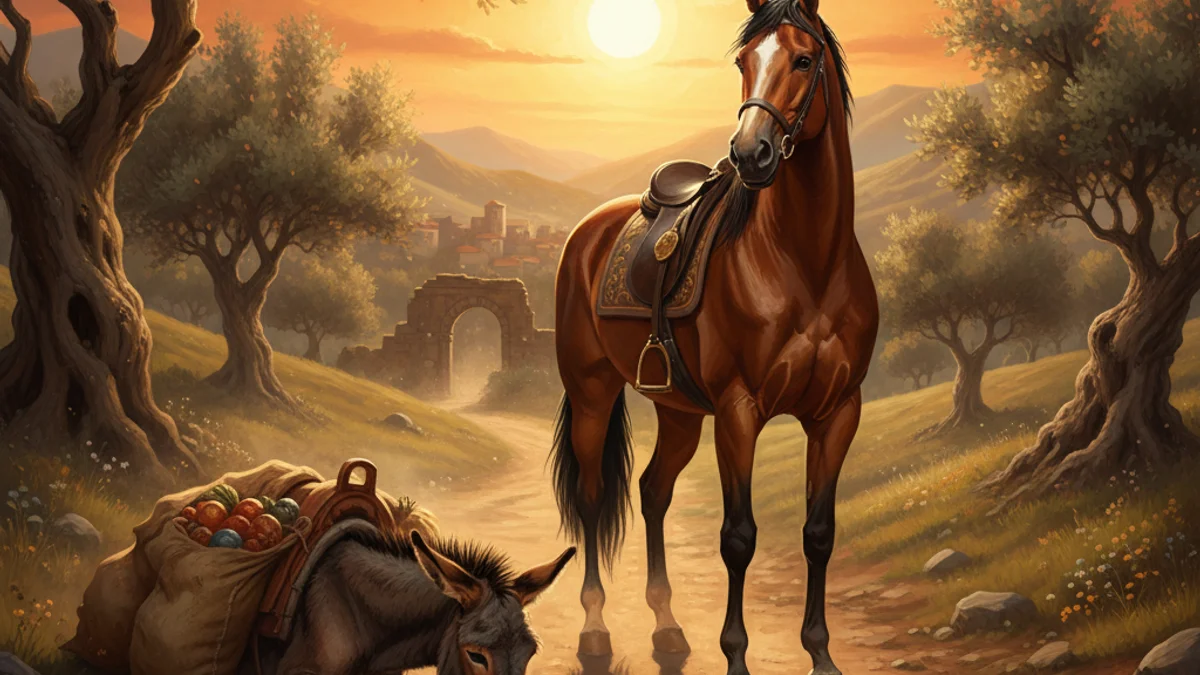
A merchant once set out on a journey to the city, driving before him a horse and a donkey. The donkey was heavily laden with massive sacks of goods, while the horse trotted along with nothing but a light, decorative saddle. As the sun rose high and the path grew steep, the donkey felt his strength failing. He turned to the horse and pleaded, 'Please, friend, take just a small portion of my burden, or I shall surely collapse before we reach our destination.' The horse, filled with pride and laziness, tossed his mane and replied, 'Why should I trouble myself? Carry your own load; I am a noble creature, not a beast of burden like you.' Not long after, the donkey’s heart gave out, and he fell dead in the dust. The merchant, having no other choice, lifted the entire load from the donkey and placed it upon the horse—adding the weight of the donkey’s hide to the pack. As the horse struggled under the crushing weight, he groaned in regret: 'Alas! By refusing to help my companion with a small task, I have brought this double burden upon myself.'
The Moral
Help others when they are in need, or their burden may soon become your own.
“By refusing to help my companion with a small task, I have brought this double burden upon myself.”
Fun Fact
This fable is frequently used in modern management and leadership training to illustrate the concept of 'shared responsibility' and the prevention of burnout within a team.
Frequently Asked Questions
What is the moral of The Horse and the Donkey?
The lesson is that we should help those in need, as refusing to share a small burden today may lead to a much heavier one tomorrow. It highlights the importance of empathy and mutual cooperation.
Who is the author of The Horse and the Donkey?
This story is part of Aesop’s Fables, a collection of tales credited to Aesop, a storyteller who lived in ancient Greece between 620 and 564 BCE. His stories use animals to teach human lessons.
Why did the horse refuse to help the donkey?
The horse refused because of his arrogance and lack of foresight. He believed himself too noble to do 'common' work and didn't realize that the donkey's survival was essential to his own comfort.
What happens to the horse at the end of the story?
After the donkey dies from exhaustion, the merchant forces the horse to carry all of the donkey's heavy cargo plus the donkey's skin. The horse suffers far more than if he had simply helped earlier.
What does the donkey symbolize in the fable?
The donkey represents the hardworking and often overlooked individuals who carry the weight of labor. His collapse serves as a warning about the consequences of neglecting those who support the system.
How does this fable apply to modern teamwork?
In modern life, it serves as a reminder that when team members are overwhelmed, others should step in. If one person fails due to lack of support, the entire team must eventually carry the extra weight.
Discussion (0)
Share your thoughts on this story
No comments yet. Be the first to share your thoughts!