Story Summary
In the Sufi parable The Man Who Fled from Death, a terrified man attempts to outrun destiny, only to find that his flight leads him to his inevitable end.
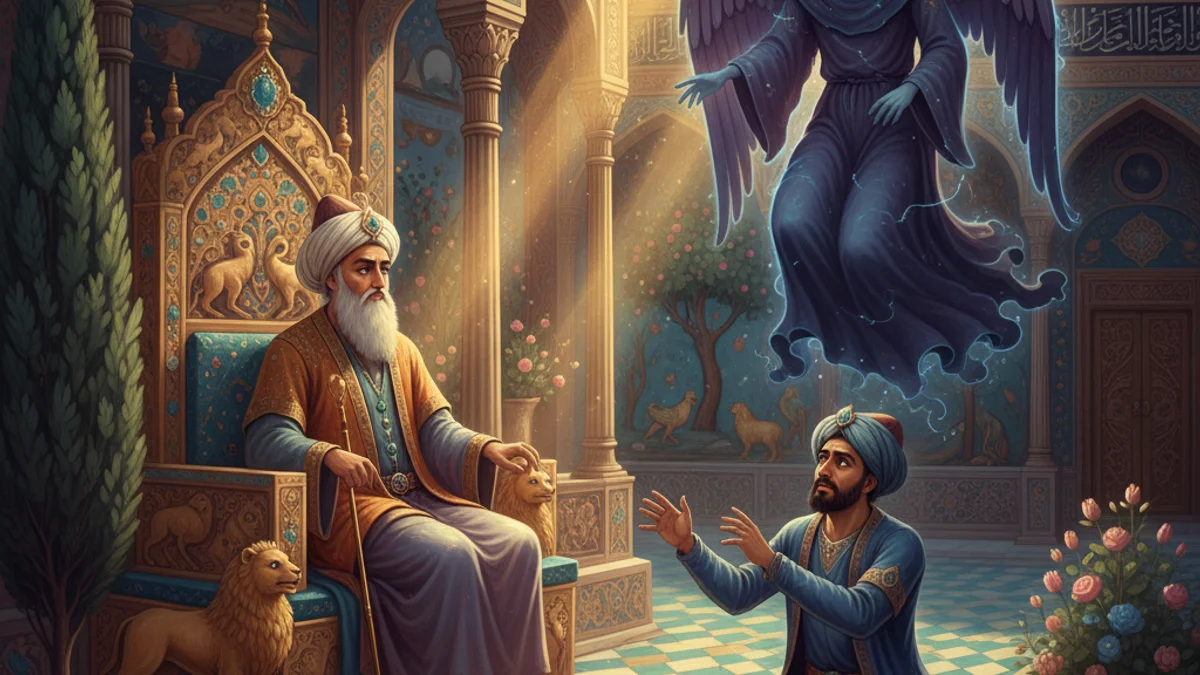
One morning, a frightened nobleman rushed into the court of Prophet Solomon, his face pale and his body trembling. He begged Solomon to save him, explaining that he had just encountered Azrael, the Angel of Death, who had given him a look of intense anger and menace. 'Please,' the man pleaded, 'command the wind to carry me to the farthest reaches of India so I may escape his reach.' Solomon, out of compassion, ordered the wind to whisk the man away to the distant land. Later that day, Solomon met the Angel of Death and asked, 'Why did you cast such a frightening look upon that poor man this morning?' Azrael replied with surprise, 'It was not a look of anger, but one of wonder. God had commanded me to take his soul in India this very evening, yet when I saw him here in your court in Israel, I wondered how he could possibly make the journey in such a short time.'
The Moral
One cannot escape destiny; the very actions we take to avoid our fate are often the means by which it is fulfilled.
“The wind of fate blows where it will, and every flight is but a journey toward home.”
Fun Fact
Rumi used this story to illustrate that death is a door that opens at a specific time, and human anxiety cannot change the lock or the key.
Frequently Asked Questions
What is the moral of The Man Who Fled from Death?
The moral is that fate is inescapable and divine decree is absolute. It teaches that the measures we take to avoid our destiny are frequently the very steps that lead us directly toward it.
Who is the author of this parable?
This story is a famous parable written by Jalaluddin Rumi, the 13th-century Persian poet and Sufi mystic. It is found in his magnum opus, the Masnavi.
Why did Solomon help the man flee to India?
Solomon helped the man out of compassion and because he possessed the miraculous power to command the winds. He did not realize at the time that he was helping the man meet his predestined end.
What does India represent in this Sufi story?
India represents a far-off, distant land that the man believed was beyond the reach of his current situation. In Sufi symbolism, it often serves as a metaphor for the farthest reaches of the material world.
Is the Angel of Death portrayed as evil in this story?
No, the Angel of Death is portrayed as a neutral servant of God's will. His 'threatening' look was actually just confusion at seeing a man in the wrong location based on divine instructions.
How does this story relate to Sufism?
It relates to the Sufi concept of 'Tawakkul' or trust in God. It suggests that since one cannot change the divine decree, it is better to find peace and surrender rather than living in a state of fearful flight.
Discussion (0)
Share your thoughts on this story
No comments yet. Be the first to share your thoughts!