Story Summary
Discover the touching tale of The Squirrel's Devotion from the Ramayana, where a tiny creature's small contribution to Lord Rama's bridge earns eternal grace.
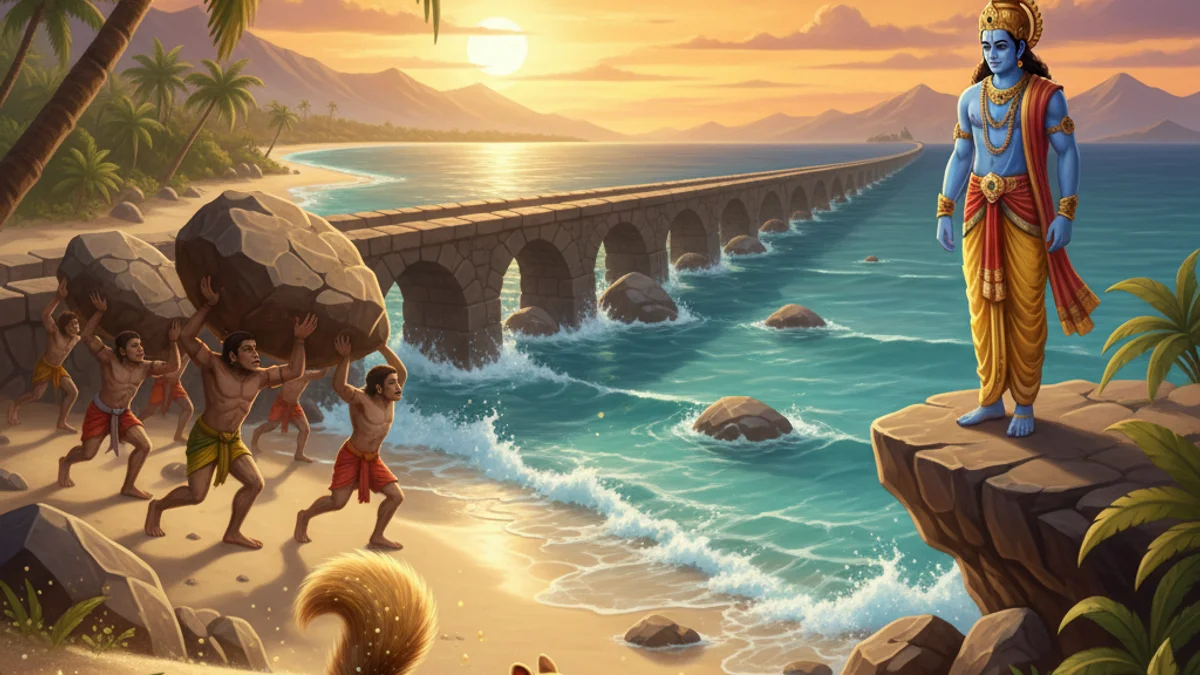
As Lord Rama and his vanara army prepared to cross the ocean to Lanka to rescue Sita, they began constructing a massive stone bridge known as the Ram Setu. The mighty monkeys carried enormous boulders and heavy rocks, throwing them into the sea with great strength. Amidst this grand labor, a tiny squirrel watched with deep devotion. Wanting to help, the squirrel began rolling in the sand, then running to the bridge to shake the grains off between the heavy stones. A monkey, seeing the small creature, laughed and told it to stay out of the way, mockingly asking what its tiny grains of sand could possibly achieve. Overhearing this, Lord Rama gently picked up the squirrel in his hand. He explained to the army that while the monkeys brought boulders, the squirrel’s sand filled the gaps, making the bridge stronger. Rama praised the squirrel’s sincere heart and stroked its back with his fingers. It is said that the three dark stripes found on squirrels today are the marks left by Lord Rama’s touch, a permanent blessing for its humble service.
The Moral
No contribution is too small if it is made with sincerity and a devoted heart.
“No task is too small, and no effort is insignificant when born of a heart full of love.”
Fun Fact
Though one of the most beloved stories in India, the tale of the squirrel's stripes is actually a later addition to the epic, primarily popularized through oral traditions and regional retellings.
Frequently Asked Questions
What is the moral of The Squirrel's Devotion?
The story teaches that every effort, regardless of its size, is valuable when done with pure intentions. It emphasizes that sincerity matters more than the magnitude of the task.
How did the squirrel get its stripes according to the Ramayana?
According to legend, Lord Rama stroked the squirrel's back with his fingers to show his appreciation. The three stripes on the squirrel’s back are believed to be the permanent marks of Rama's fingers.
Who noticed the squirrel's hard work in the Ramayana?
While the monkeys initially mocked the squirrel for its small contribution, Lord Rama noticed its efforts and defended the creature, highlighting the importance of its devotion.
Why was the squirrel helping Lord Rama?
The squirrel was a devotee of Lord Rama and wanted to contribute its small part in the grand mission to rescue Sita and defeat the demon king Ravana.
What was the bridge being built for?
The bridge, known as Ram Setu, was being built across the ocean to connect India to Lanka so that Rama’s army could reach Ravana's kingdom.
Is the story of the squirrel in the original Valmiki Ramayana?
Interestingly, this popular story is not found in Valmiki's original Sanskrit text but appears in later versions like the Ramcharitmanas and various regional folk traditions.